Summary:
Door to door sales is still a major global industry, with direct selling generating roughly $164 billion worldwide in 2024 and the broader market on pace to top $280 billion by 2030. The US remains the top single market, and industries like roofing, solar, pest control, and home security still rely heavily on knocking doors to grow. Technology has changed how reps target homes and follow up, but trust and persistence still decide who wins the job. Knockio helps home service teams turn that knock into a tracked, connected job from the first conversation through the final payment.
Summarize with:
Door to door sales is one of the oldest job creation engines in the world, and it is still one of the strongest. This guide breaks down the real numbers behind the industry: where it came from, how big it is today, which industries depend on it, and where it is headed next. If you run a roofing, solar, HVAC, pest control, or home improvement company, this is the data you need to plan your next canvassing season with confidence.
In this guide, you will find:
- A short history of door to door selling
- Current global and US direct selling numbers
- The industries that still rely on knocking doors
- How technology has changed the day to day work of a rep
- The real challenges reps and companies face in 2026
- Full sales, prospecting, and closing statistics
- Where the industry is headed next
By covering all these topics, this report becomes a complete and reliable guide to door‑to‑door selling.
A Short History of Door to Door Selling
Door to door selling is not a new idea. Pedlars and hawkers were walking from house to house selling brushes, pots, and pans long before the first department store opened its doors. When shops, mail order catalogs, and eventually the internet arrived, this old way of selling faded for a while. You can read more about that early history on Wikipedia.
It came back strong in the 1950s and 60s. Encyclopedia sets, Tupperware, and Avon cosmetics turned front porches into showrooms across the US and Europe. Avon has been selling this way for more than 135 years. Even though most of its sales now happen online, the company’s history proves something simple: a real conversation at someone’s door still works.
That is still true today. A rep explaining a roof inspection or a solar quote is doing the same job a brush salesman did a century ago. Show up, have a real conversation, build trust, and close the job. The tools have changed. The core of door to door sales has not.
The Global Direct Selling Market Today
Door to door selling is far from dead. It is a market worth well over $150 billion a year, and it has held steady even through years that hurt most other industries.
According to the World Federation of Direct Selling Associations, global direct selling retail sales came in at roughly $163.9 billion in 2024, essentially flat compared to the year before but still above pre pandemic levels. Nearly half of the markets tracked by WFDSA actually grew that year. More than 104 million people work as independent direct sellers worldwide, and 72 percent of them are women. Twenty one countries now count as billion dollar markets, and together they make up over 90 percent of global sales.
Zoom out to the wider direct selling and door to door market, and the growth story gets even stronger. Analysts at The Business Research Company put the global direct selling market at roughly $207 billion in 2025, growing to about $220 billion in 2026, a 6.4 percent annual growth rate. Their forecast has the market crossing $280 billion by 2030, driven largely by AI powered sales tools, mobile commerce, and companies personalizing the door knock instead of guessing which houses to hit. You can dig into the full breakdown in this market report.
The takeaway for a home service business owner is simple. This is not a shrinking channel. It is a channel that is getting smarter.
With Knockio
The companies pulling ahead in a growing but competitive market are the ones who know exactly where their reps have been and what happened at every door. Knockio gives managers map based territory visibility, so they can see which streets are covered, which reps need backup, and which areas are being worked twice for no reason. When a homeowner says yes, that address does not just become a name on a list. It becomes a job in Knockio, carrying the address, notes, photos, and every appointment tied to it from the very first knock.
The US Door to Door Sales Market
The United States remains the single largest direct selling market in the world. According to WFDSA, the US generated about $34.7 billion in direct selling sales in 2024, a slight pullback from the year before, but still the top market globally by a wide margin.
This is not a business built only on makeup and kitchenware anymore. It covers roofing, solar, pest control, security, internet service, lawn care, and dozens of other home service categories. Flexible hours and uncapped commission still pull in a mix of college students, retirees, and people who simply do not want a desk job.
What has changed is the process. A rep today might see a Facebook post about a storm, message a homeowner about it, then knock the next day to follow up in person. That blend of digital outreach and face to face conversation is what kept US door to door sales strong through the pandemic years and it is still the playbook companies use now.
With Knockio
When a homeowner says yes at the door, that moment should not live only in a rep’s head or a paper notepad. In Knockio, a job carries the homeowner’s information, the address, notes from the conversation, any photos taken on site, and a status that tells the whole team exactly where that job stands. Nothing gets lost between the knock and the appointment.
Major Players and the Industries Still Knocking
Door to door selling is not run by one company. It is a method used across dozens of industries.
Amway, based in Michigan, is often called the largest direct seller in the world, generating around $8 billion a year. Avon, Mary Kay, and Herbalife built massive sales forces the same way, person to person, often starting at someone’s front door.
Outside of the classic direct selling brands, seven industries still lean on door knocking more than any others: cable and phone plans, solar panels, gas and electricity, home security, lawn and garden care, home repair, and multi level marketing products. Home improvement and telecom bring in the most revenue of the group.
Roofing is one of the clearest examples. After a hailstorm, it is common to see multiple roofing crews working the same neighborhood within days, offering free inspections for storm damage. One Minnesota homeowner reported nine different roofers knocking on his door after a single storm. That kind of competition is exactly why speed and organization matter so much for a canvassing team.
Pest control tells a similar story. Door to door pest control sales grew from about $200 million in 2015 to more than $1 billion by 2022. Orkin and Terminix still run door knocking teams to sign homeowners up for annual plans.
Home security followed the same path. Vivint Smart Home built its customer base almost entirely through door knocking teams, signing up more than 3 million US customers and paying roughly $300 million in commissions to its reps in 2022 alone. The company was eventually acquired for $2.8 billion, proof that a well run door to door sales operation can build serious enterprise value.
With Knockio
Every one of these industries runs into the same operational problem once the knock turns into a sale. The job has to move from the doorstep to the office to the crew without anything falling through the cracks. Knockio’s dynamic job statuses let a roofing, solar, pest control, or security company build a board that matches exactly how their team works, from lead to inspection to signed estimate to scheduled crew to invoice. Board view shows every job at its current stage, so a sales manager and a production manager can look at the same board and both understand exactly where things stand.
Technology in Door to Door Sales
The heart of door to door selling has not changed. It is still a face to face conversation. What has changed is how reps prepare for that conversation and what they carry into it.
Instead of knocking on every door on a street, teams now use data and mapping tools to target the houses most likely to say yes. Route planning apps cut down on wasted driving time. Mobile sales software lets reps log a lead, build an estimate, and collect a signature without ever pulling out a paper form. Many reps now close a sale on the spot, tablet in hand, before they walk to the next house.
Communication has changed too. Managers send live updates through group chats and sales apps. Roofing and solar teams sometimes use drones or satellite imagery to check a roof before they ever knock. At the same time, reps build early trust online, posting in local Facebook groups or Nextdoor before showing up in person to follow up with people who already engaged.
Smart doorbells like Ring and Nest have added a new wrinkle. Homeowners can see who is at the door before they answer, which means reps need to look and act more professional than ever. Clear company badges, appointment scheduling, and a straightforward introduction all matter more in a world where every visit might be recorded.
With Knockio
This is where Knockio’s Automation Flow Builder earns its keep. Once a rep captures a lead in the field, Knockio can automatically trigger a follow up text, schedule a callback task for a manager, or send an appointment reminder, all without anyone in the office lifting a finger. Live rep tracking gives managers real time visibility into where the team is working, which streets have been covered, and which reps might need support mid shift. This is not about watching people. It is about protecting the day. A manager who can see a rep stuck in a weak area can redirect them before the whole shift is wasted.
Challenges Reps Still Face
Knocking on doors has never been easy, and it is not getting easier.
In one UK survey, 82 percent of people said they dislike doorstep selling in any form. Scam calls and phishing attempts have made people more suspicious of strangers in general, which means a rep now has to earn trust before they can even start talking about the product. Busy two income households, “No Soliciting” signs, and local permit requirements all add friction. Some towns have outright bans on commercial door knocking, known as Green River Ordinances in the US.
The physical and emotional toll is real too. Reps walk for hours in all kinds of weather, hear “no” far more often than “yes,” and many quit within their first few months because of it. Safety matters as well. Companies often require reps to check in through an app or work certain areas in pairs.
Health concerns from the pandemic years still linger for some homeowners, even years later. The companies that have handled this well are the ones who stayed transparent: showing ID clearly, respecting posted signs, and training reps to handle rejection calmly instead of pushing harder.
None of this makes the job easy. It does explain why the reps and companies who master it still see it as one of the most direct paths to real, fast revenue in home services.
With Knockio
A lot of the friction in door to door sales comes down to lack of information. A rep who does not know a homeowner was already visited last week, or a manager who cannot tell which areas have already been worked, ends up wasting time and annoying homeowners. Knockio’s territory and job history tools solve that. Every past visit, note, and outcome tied to an address is visible to the team, so reps show up prepared instead of guessing.
Door to Door and Direct Sales Statistics
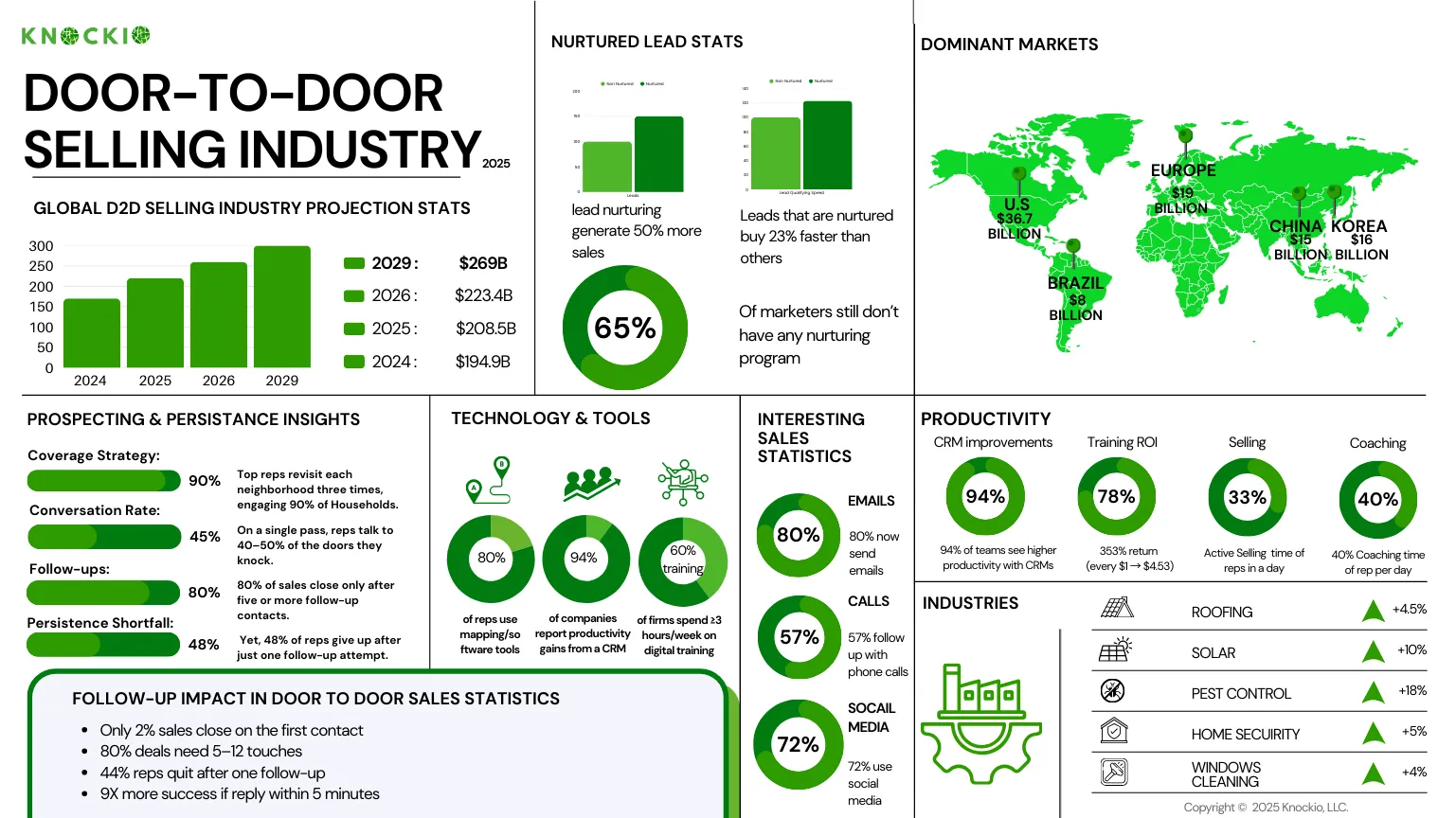
The US remains the top door to door and direct selling market in the world, followed by China, South Korea, and Brazil, with Europe close behind. Together these regions make up the bulk of a global direct selling market now valued at roughly $207 billion, on pace to top $280 billion by 2030 according to The Business Research Company.
Below is a breakdown of statistics across the sales methods that home service teams actually use day to day, from inside sales to field canvassing to referrals and follow ups.
Inside Sales Teams
Inside sales now accounts for close to 40 percent of deals, up from just 10 percent in 2017. Inside reps can reach roughly four times as many prospects at about half the cost of field teams, and the vendor who responds to a lead first wins 35 to 50 percent of the time. Even so, inside reps spend only about a third of their day actually selling, with the rest eaten up by admin work and contact research. (McKinsey; Salesroom State of Sales; CSO Insights; Inside Sales)
Field Sales
Field sales is not going anywhere, but it is blending with digital outreach. Most companies now run a hybrid model that mixes video calls with traditional in person visits, and hybrid teams see about 50 percent more revenue growth than teams that are purely digital or purely field based. This hybrid approach also widens the hiring pool, since reps are no longer limited to a single service area for prospecting work. (Forrester; McKinsey)
Prospecting
Forty two percent of reps say prospecting is the hardest part of their job. Most prospects still say they prefer an initial email, while over half of executives still favor a phone call first. In person events remain surprisingly strong, generating about a third of all leads. Most deals need five or more follow up touches to close, yet the majority of reps give up after only four attempts. (HubSpot; Rain Group; Gartner via Qwilr; Close.com)
Cold Calling
Cold calling is still alive. About 27 percent of reps say phone outreach works well for them, even though only 2 percent of calls turn directly into a meeting. It typically takes eight dial attempts to reach a prospect and closer to eighteen to build a real connection. Nearly half of reps give up after one call, despite data showing that extra follow ups can boost conversions by up to 70 percent. (Zendesk; Leap Job; CallHippo; Ringlead; Close.com)
Social Selling
Reps who use a real LinkedIn strategy are about 51 percent more likely to hit quota, and most organizations that invest in social selling see measurable revenue growth from it. Three out of four B2B buyers now research vendors on social media before ever talking to a rep. (LinkedIn; Resamaze; Phoenix Consulting; HubSpot)
Referrals
Referrals convert better than almost any other channel. Over 90 percent of consumers trust a recommendation from a friend or family member, referred customers spend more, and companies with a formal referral program grow revenue significantly faster than companies without one. Yet only about 30 percent of businesses actually run a structured referral program. (DemandSage; TrueList; Exploding Topics; WinSavvy)
Email marketing still delivers one of the best returns of any channel, generating roughly $36 for every $1 spent. With around 20 percent average open rates and most opens now happening on mobile first, a short, specific subject line matters more than ever. Personalized subject lines can boost open rates by as much as 50 percent. (HubSpot; Oberlo; The Loop Marketing)
Follow Ups
Only about 2 percent of sales close on the very first contact. Most deals need somewhere between five and twelve touches, yet a large share of reps give up after just one attempt. Responding within five minutes of a new lead can boost engagement nearly ninefold compared to waiting even a little longer. (GrowthList; Peak Sales Recruiting)
Closing Rates
On average, only about one in five opportunities actually turns into a closed deal, with software companies closing slightly better than most other industries. Sales cycles have also been stretching longer in recent years, which is part of why nearly a third of field sales leaders say closing deals feels harder now than it did a year ago. (HubSpot; Tomasz Tunguz; SPOTIO’s 2025 State of Field Sales report; WebStrategies Inc)
Lead Nurturing
Nurtured leads produce about 20 percent more sales opportunities at roughly a third lower cost, and they move through the pipeline noticeably faster than leads left alone. Companies using marketing automation for nurturing have reported jumps of over 400 percent in qualified leads. Even so, most marketers still do not have a formal nurturing process in place, which is a real gap most competitors are not closing. (HubSpot; BeBusinessed; Ascend2; DemandGen; Forrester; Annuitas Group; Marketo)
Lead Quality
Nearly half of B2B companies say generating enough leads is their biggest challenge, but the deeper issue is often quality, not quantity. Fewer than 40 percent of companies consistently score and qualify their leads before handing them to sales. Response speed matters enormously here too: waiting even ten minutes to respond to a new lead can cut your odds of qualifying it by roughly four times compared to responding in five. (Sopro; MarketingSherpa; DecisionTree; Gleanster; Harvard Business Review; HubSpot)
Outbound Sales
Outbound still works. Roughly two thirds of buyers say they will take a cold call. Persistence is still the differentiator: most deals need at least five follow ups, but nearly half of reps quit after the first try. Companies that align their sales and marketing teams see meaningfully higher customer retention and win rates as a result. (HubSpot; Sales Insights Lab; DemandGen; Salesloft; RAIN Group; Marketo)
Inbound Marketing
Fifty nine percent of marketers say inbound produces higher quality leads than outbound. Most B2B buyers now do the majority of their research online before ever speaking to a sales rep, and companies that align their sales and marketing content see stronger revenue outcomes as a result. (HubSpot; Salesforce State of Sales; DemandGen Report; Content Marketing Institute; Edelman Trust Barometer)
More Data Behind the Numbers
B2B Buyer Behavior
A typical B2B purchase involves around seven people in the decision. Buyers now do the majority of their research online before ever talking to a sales rep, reviewing several vendor websites along the way. Most senior decision makers use social media to inform their choices, and referrals still play an outsized role in who gets the first meeting. (Gartner; Worldwide Business Research; Digital Commerce 360; B2B PR Sense; Harvard Business Review; McKinsey)
Productivity and Technology
Sales reps still spend less than a third of their day on actual selling, with the rest lost to admin work and logistics. Nearly half of managers say holding field teams accountable is a real struggle. That said, top performing teams use sales technology roughly three times more often than average teams, and AI powered automation is expected to cut manual admin work dramatically over the next few years. (Salesforce State of Sales; Alore.io; Teal; EBSTA B2B Benchmark; SPOTIO; Learn to Win)
Training and Coaching
Companies that invest in ongoing coaching see real results. Every dollar spent on training has been shown to return over $4 in value, and consistent coaching can boost a rep’s net sales by roughly 50 percent. Without regular refreshers, most training is forgotten within weeks, which is why high growth companies lean toward shorter, more frequent coaching over one time onboarding. (Qwilr; Salesloft; SalesBlink; Mailshake; Salesforce)
What Top Performers Have in Common
Top reps consistently use collaborative language, asking about a buyer’s goals instead of jumping straight into a pitch. They also bounce back from rejection faster than average performers, even when their raw skill level is similar. Persistence remains the clearest pattern: most closed deals needed five or more follow ups, and many buyers say “no” several times before finally saying “yes.” (Slack; HubSpot; Spekit; Salesgenie)
CRM Adoption
Businesses that adopt a CRM report meaningfully higher productivity, better forecast accuracy, and more sales overall. Most companies now run their CRM in the cloud, and the vast majority of sales leaders expect AI to play a bigger role in how their CRM works within the next couple of years. (Flowlu; Nutshell; RevOpsTeam; Email Vendor Selection)
Door to Door Specific Numbers
Even with every other channel in the mix, face to face knocking still converts at a real rate: 2 to 3 percent of knocks turn into a lead, and top performers who canvass an area three separate times can reach around 90 percent of homes in it. That usually works out to roughly one lead for every 50 doors knocked. Success in this channel still comes down to the same three things it always has: persistence, genuine rapport, and knowing which doors are worth knocking in the first place. (Zety; Sunbase; Grand View Research)
With Knockio
Numbers like these are exactly why territory planning and rep tracking matter so much. A team that can see coverage data in real time can push a rep back into a weak area or pull them out of an oversaturated one before the day is wasted. Knockio’s map view, territory assignment, and activity history give managers the information they need to turn raw knock counts into a real, repeatable strategy instead of guesswork.
What Comes Next for Door to Door Sales
E commerce and digital ads are not making the knock obsolete. Most industry analysts expect the opposite: door to door selling is becoming more targeted, not less relevant. Personal trust still closes home service jobs faster than any ad campaign, and that is not likely to change soon.
What is changing is the order of operations. More companies are moving toward a model where a homeowner fills out an online form or interacts on social media first, and the knock becomes a warm follow up instead of a cold introduction. That single shift makes the whole visit friendlier and more productive for everyone involved.
Roofing is a strong example of where this is headed. Roof related repair and replacement spending in the US hit nearly $31 billion in 2024, up roughly 30 percent since 2022, driven by storm activity and tightening insurance requirements on older roofs. With more than 101,000 roofing companies now operating across the country, competition for every homeowner’s attention has never been higher. That is exactly the kind of market where organized, well tracked canvassing beats a scattershot approach.
Direct selling as a whole is following the same pattern: global sales are forecast to climb from around $207 billion in 2025 to over $280 billion by 2029, according to The Business Research Company. The channel is not shrinking. It is getting sharper, more digital, and more competitive, which means the companies with the best systems behind their reps are the ones who will win the most jobs.
If your team is still juggling a canvassing app, a separate CRM, a scheduling tool, and a spreadsheet for invoices, that is exactly the kind of setup Knockio was built to replace. One system for rep tracking, job management, estimates, work orders, and payments means nothing gets lost between the first knock and the final payment.
Sources:
Global direct selling market (2024 figures, rep counts, billion-dollar markets)
- WFDSA Global Statistics page: https://wfdsa.org/global-statistics/
- WFDSA 2024 STATS Report (PDF): https://wfdsa.org/wp-content/uploads/2025/12/WFDSA-STATS-Report-2024-2025-V1.pdf
- Direct Selling News coverage of the report: https://www.directsellingnews.com/2025/12/08/wfdsa-releases-annual-stats-report/
- PR Newswire release: https://www.prnewswire.com/news-releases/direct-selling-remained-steady-in-2024-amid-global-economic-shifts-according-to-wfdsa-stats-report-302633355.html
US direct selling market (2024, $34.7B figure)
- Referenced within the WFDSA STATS report above, and corroborated by: https://evolvancemarketresearch.com/reports/direct-selling-market/
Global growth forecast ($207B → $220B → $281B by 2030)
- The Business Research Company, Direct Selling Global Market Report 2026: https://www.thebusinessresearchcompany.com/report/direct-selling-global-market-report
- Same data mirrored here: https://www.giiresearch.com/report/tbrc1961585-direct-selling-global-market-report.html
Roofing industry figures (2024 claims spend, contractor count)
- Fixr.com, U.S. Roofing Industry Statistics 2025: https://www.fixr.com/articles/us-roofing-industry-statistics (this page cites Verisk’s claims-cost data and IBISWorld’s contractor counts)

Waqar Hussain leads SEO and digital media at Knockio, a field sales and field service management (FSM) platform for businesses managing sales reps, field teams, jobs, and customer appointments. He focuses on content strategy, search growth, and digital media to help more teams discover better ways to manage leads, jobs, and field operations.