Summary:
A field service CRM is built for teams that leave the office, not just track leads at a desk. It connects scheduling, dispatch, job notes, photos, contracts, and invoices into one flow so nothing gets lost between the sale and the finished job. For home service businesses, it brings order to busy days, gives owners real visibility into the field, and keeps every job moving from first call to final payment. Knockio handles both the sales side and the field side in one connected system.
Summarize with:
If you run a home service business, your day is never just about answering the phone. You are scheduling jobs, planning routes, keeping crews moving, tracking photos from the field, ordering parts, sending invoices, and chasing the follow ups that never seem to end.
Then come the small things that quietly wreck a morning. A missing address. A tech who shows up without the right notes. A customer who calls to ask, “When will he be here?” and nobody can give a straight answer.
This is where a Field Service CRM earns its keep. Think of it as the control center for your whole operation. A standard CRM stores names and emails. A field service CRM is built for teams on the move, so it handles the real work: dispatching, live schedules, job notes, and proof that the job was actually done.
A regular CRM tracks contacts and deals. A field service version goes further. It tracks people and jobs in real time, so you always know what is happening out in the field.
In plain terms, it pulls the mess out of your day and turns it into something repeatable. You get your time back and spend it on the work, not the paperwork.
Why a Field Service CRM Is Not Just Another CRM
When most owners hear the word CRM, they picture a sales tool for tracking leads and closing deals. That is fair. But closing the deal is only half the job for a service company.
A sales CRM works great for someone at a desk moving a name from “Lead” to “Proposal.” Your team does the harder part. They load the truck, drive out, and do the work.
That is why field teams need more than a sales tool. You need a system that understands the gap between selling a job and running one. Something that stays with you after the contract is signed, when the crew is on site and the customer is waiting for results.
This is also where the language matters. Once the sale is done, you are no longer chasing a lead. You are running a job. And a job carries a lot more than a name and a phone number.
CRM vs Field Service CRM
At a glance, the two sound the same. Both keep track of customers. But they were built for very different sides of the business.
A standard CRM is good at answering questions like:
- Who is the lead?
- What stage is the deal in?
- When is the next follow up?
- What did we quote?
A field service CRM answers all of that, then keeps going into the questions that decide whether your day runs smoothly:
- Who is assigned to this job today?
- What is the gate code or the exact site address?
- What is the best route for the crew?
- Did the tech upload photos and notes from the site?
- Did the customer sign off?
- Has the invoice gone out and been paid?
That is the difference between holding information and having control. One is a list of contacts. The other is a live board that keeps the day moving.
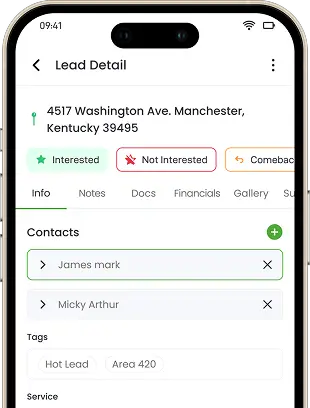
In a system like Knockio, that live board is real. A job carries everything in one record: customer details, address, contacts, assignees, custom fields, notes, surveys, appointments, photos, files, estimates, invoices, payments, and the full activity history. Nothing is scattered across apps, because everything lives on the job.
The Real Problem It Solves
Most home service businesses do not struggle because work is slow. They struggle because the work starts to feel like a mess.
It turns into a frustrating loop. More calls, more cancellations. More techs, more mistakes to fix. More office help, somehow more confusion. You are working harder than ever, and the profit still is not showing up in the bank.
A field service CRM brings order by making every job visible and shared. It pulls the details out of people’s heads and puts them in one place the whole team can see.
With Knockio, that shared view runs on job statuses. You can build your own status names, assign roles to them, and use them to power the way your team actually works. A job moves through stages everyone recognizes, and no one has to guess where it stands.
What “Job Flow” Means in Simple Words
Job flow is the path a job takes, from the first hello to the final thank you.
Most jobs follow the same rhythm:
- A lead reaches out by phone or web form.
- You check if it is a good fit.
- You get a visit on the calendar.
- You assign the right tech.
- The work gets done on site.
- Photos and notes are saved to the job.
- An invoice goes out.
- The payment comes in.
- You follow up for a review or future work.
When your tools are scattered, this chain snaps. Calls live in one app, notes hide in a group chat, the schedule is on a whiteboard, and photos sit on a tech’s personal phone. You chase invoices in one tool and try to remember follow ups in your head.
A field service CRM links these steps into one continuous flow. In Knockio, that flow is built in. An appointment becomes a scheduled job. The job moves to an assigned crew with a work order. The crew adds photos and notes. An invoice goes out, and the payment lands back on the same record. Nothing falls through the cracks because nothing leaves the job.
Who Actually Needs a Field Service CRM?
Not every business needs one. But if your day means managing crews, juggling service calls, and reshuffling the schedule, you need a real field service management system.
HVAC Companies
HVAC teams live with urgent calls, seasonal rushes, and steady maintenance work. To keep your head above water, you need fast booking, smart routing, and clear notes. There is nothing worse than a tech walking up to a unit with no history, no model numbers, and no warranty details. You burn time and lose trust.
A field service HVAC CRM keeps service history on the job, so the right tech shows up ready. In Knockio, that history follows the customer. Past visits, notes, uploaded photos, and prior invoices all sit on the record, and the assigned tech can see them before pulling into the driveway.
Plumbing Businesses
Plumbing is fast and unpredictable. A quick fix can turn ugly in five minutes. And when your office cannot see job status in real time, they spend all day fielding “Where is my plumber?” calls.
A solid Plumbing CRM ends that. With Knockio, dispatch is clean, the plumber updates the job status from the field, and photos go straight onto the job as proof the work was done right. The office sees the change the moment it happens, so they can answer the customer without calling the tech.
Solar Sales and Install Teams
Solar mixes heavy sales with heavy field work. You are tracking leads, site surveys, permits, installs, and follow ups all at once.
When sales boom but operations lag, you get delays and refund requests. A field service CRM ties lead handling to scheduling, document tracking, and post install follow up. Knockio carries the whole path: a rep captures the lead and homeowner data in the field, books the appointment, the job moves into production with work orders and tasks, and the activity history keeps sales and install crews looking at the same record.
Roofing Contractors
Roofing is a long chain of steps. Inspection, estimate, contract, materials, then the crew schedule. A standard Roofing CRM may help you close, then go quiet once the real work starts.
Roofing teams need clear job stages, task tracking, photo and document management, and crew assignments that nobody argues over. Knockio handles the part most tools drop. The signed contract triggers production: work orders for the crew or subs, material takeoffs tied to inventory, purchase orders, vendor bills, and a full photo trail on the job. Territory mapping and route planning also make those first inspections faster to reach.
How a Field Service CRM Improves Operations
Picture your business as a chain. Every weak link adds a delay. A field service CRM strengthens a few key links.
Speed
Things move faster when you are not digging through three notebooks for a gate code. You book a call, dispatch a pro, and close a ticket in half the time. Everything lives in one place, so nobody loses minutes hunting for a phone number across apps and messages.
Accuracy
Wrong addresses, missing notes, double bookings. Those headaches shrink when information is entered once and reused everywhere. When you stop relying on messy handwriting and verbal handoffs, errors drop on their own.
Visibility
This is the big one for owners. Instead of calling five people to find out where everyone is, you can see it. With Knockio’s map view, board view, and live rep activity, you watch where work is moving, where follow up is needed, and which jobs need attention before the day slips away. This is not about spying on people. It is about field control, so a manager can step in and help while the work is still happening.
Customer Experience
Customers care about two things. Did you show up on time, and did you fix the problem. A field service CRM helps with both without you hovering over every step. You send a quick “on my way” text, keep a clean record of the visit, and follow up like a pro once the work is done. In Knockio, those reminders and messages can fire automatically through the Automation Flow Builder, so the follow up does not depend on someone remembering.
Profit and Repeat Work
Less chaos means fewer mistakes. Fewer mistakes means fewer apology refunds, fewer unpaid return trips, and better reviews. Those five star reviews bring in more leads, which brings more growth. Instead of putting out fires all day, your business starts running in a steady, profitable loop.
Simple Job Flow Examples You Can Picture
Here is how this plays out on a normal Tuesday.
Example 1: HVAC Repair Call
The call comes in at 10 AM. The AC died on a hot day, and the office marks it as an emergency repair right away.
The system flags who is nearby with an open slot, so nobody calls every tech on the roster. The assigned tech gets the address, the gate code, and the unit’s history on their phone. They mark themselves “On the way,” which updates the office and the customer at once.
When the fix is done, the tech logs the parts used and snaps photos before leaving. The invoice goes out fast, and the customer pays digitally. A reminder is set to reach back out next season for a tune up.
The win here is simple. No guesswork, no frantic calls, no missed steps. In Knockio, the same job carries the status update, the photos, the invoice, and the payment, and the next season reminder can run on its own.
Example 2: Plumbing Leak Job
A homeowner finds a leak and fills out your form. It lands in the system instantly, so nobody retypes the details. The office calls right away to confirm before the homeowner thinks about calling a competitor.
You can see the full schedule, so you book a same day visit with no guessing. The plumber gets the gate code and notes on their phone and heads straight to work. They take before and after photos on site, which protects you if a dispute ever comes up.
The customer signs off on a tablet, an invoice is generated, and they pay on the spot. With Knockio’s text to pay, tap to pay, card, and ACH options, that payment can happen right at the door, and the job record updates the moment it clears. By the next morning, a review request goes out while they are still happy.
Example 3: Roofing Inspection to Contract
A roofing job really starts when a homeowner asks for an inspection. The request is tagged and assigned to the right rep using territory mapping. The rep schedules the visit, completes it, and uploads photos and notes from the roof. A clear quote and proposal go out, and the customer signs the contract digitally, no mailing required.
This is where basic CRMs quit, because they think the sale was the finish line. With a field service system, the signed contract is the starting gun for production. In Knockio, that estimate can use templates, optional line items, a digital signature, and customer acceptance, then become a work order with tasks, materials, schedules, and vendor bills. The work keeps living in one system long after the deal is closed.
CRM vs Field Service CRM vs Knockio
Side by side, the differences get clear fast. Here is a practical comparison based on what service businesses deal with every day.
| Feature Area | Standard CRM | Basic Field Service Software | Knockio Field Service CRM |
|---|---|---|---|
| Lead Management | Strong | Basic | Strong, built for service jobs |
| Work Pipeline | Limited to sales stages | Job stages, often rigid | Drag and drop boards with custom statuses |
| Scheduling | Often weak | Strong | Strong, with full job context |
| Technician Tracking | Rare | Sometimes | Real time map and activity |
| Route Planning | Rare | Sometimes | Built in mapping and routing |
| Territory Mapping | Rare | Rare | Included for teams and reps |
| Notes and Photos | Not core | Usually yes | Full document and photo management |
| Proposals and Quoting | Sales focused | Sometimes | Estimate to invoice workflow |
| Digital Contracts | Usually an add on | Sometimes | Built in e signatures |
| Invoicing | Often external | Sometimes | Built in invoicing and payments |
| Task Tracking | Basic | Sometimes | Role based task management |
| Reporting | Sales reports | Job reports | Sales, field service, and team data |
| Automation | Rare | Limited | Automation Flow Builder for reminders and updates |
| Best For | Desk based sales | Simple dispatch | Full sales plus field execution |
What sets Knockio apart is the one system approach. Instead of making your office staff and crews bounce between apps and spreadsheets, it runs lead handling, daily operations, and on site execution in one connected flow.
The Features That Matter Most in Real Life
Plenty of tools brag about hundreds of features. That looks great on a sales page, but as an owner you only care about the handful that make your day easier.
Work Pipeline Built for Jobs
Your board should show what is happening on the ground, not just sales stages. It should follow the real life of a job: new lead, needs a callback, scheduled, assigned, in progress, completed, invoiced, paid.
Knockio handles this with boards and custom statuses you control. A job shows up in a board stage when it has a status that lives on that board, and you can build separate boards for different teams, job types, or workflows. Your crew always knows where things stand.
Scheduling With Ownership
Most slip ups happen because nobody owns the schedule. A good system makes assignments clear and visible, and lets you adjust fast when something changes. In Knockio, an appointment turns into an assigned job and a work order, so the handoff from “booked” to “in progress” never lives in someone’s memory.
Technician Visibility
The day gets easier when you can see where your team is. Delays are simpler to manage when you know what is happening in the field. Knockio’s live tracking and map view keep the sales side and the service side in sync, so a manager can spot a rep stuck in a slow area or send help before lunch.
Route Planning and Mapping
Driving quietly drains money. Fuel, wages, and unpaid time add up. Smart routing trims the waste and fits more jobs into the same day.
Documents and Photos Inside the Job
Photos and notes head off disputes and repeat visits. By keeping document and photo management on the job itself, Knockio makes sure nothing worth remembering gets lost. Every file, image, and note stays attached to the record it belongs to.
Quoting, Contracts, and Invoice Flow
Take more than a few days to send a quote and you usually lose the deal. Slow invoicing chokes your cash flow. Knockio links estimates, digital contracts, and invoicing into one path, with templates, optional line items, and customer acceptance, so work keeps moving instead of stalling in admin.
Why Knockio Fits Home Services So Well
Home service businesses do not run on one kind of work. You juggle fast service calls, multi day projects, high pressure sales, and plain dispatching. A lot of jobs need photos, approvals, paperwork, and clear communication after the work wraps.
Knockio is built for that mix, in one place:
- Door to door and inbound lead handling
- CRM style lead and job management
- Boards with drag and drop stages and custom statuses
- Appointment scheduling
- Mapping, territory planning, and routing
- Real time team tracking
- Estimates, proposals, and product catalogs
- Digital contracts and customer acceptance
- Work orders, tasks, materials, and vendor bills
- Inventory with SKUs, cost, markup, and low stock alerts
- Invoicing and payments by text to pay, tap to pay, card, ACH, or manual entry
- Automation for reminders, follow ups, and job updates
- Reporting on jobs, teams, and performance
You do not have to bolt five tools together and pray they talk to each other. Your team runs everything from one system built for how home service work actually moves.
What It Looks Like When You Do Not Have One
To see why the system matters, look at what happens without it.
When there is no real field service software, the same problems keep circling back:
- Leads slip away because calls are not logged
- Double bookings and missed appointments pile up
- Techs arrive with no history and no clear instructions
- Customers keep calling just to ask for an ETA
- There is no solid proof of work, so disputes grow
- Invoices go out late, and cash flow gets tight
- Owners stay stuck working in the business instead of on it
If any of that hits home, service management software is not a luxury. It is a control system that finally lets you step out of the daily grind and start growing.
How to Choose the Right Platform
There are a lot of options, which makes the choice feel hard. The goal is not the tool with the most features. It is the one that fits how you already work.
Fit for Your Job Type
A tool built for desk sales will fight you out in the field. Your system should match your workflow, not force your crews to change how jobs run.
Speed of Use
If booking one job takes twelve clicks, your staff will quit the tool and go back to paper.
Mobile Friendly
Techs use the app in the rain, on a ladder, with customers waiting. The mobile experience cannot be clunky.
Visibility for Owners
You should see the state of the day at a glance. Dashboards and reports that show where the trucks are, which jobs are lagging, and where profit is leaking.
One Connected System
If running one job takes three logins, the system has already failed. When tools are not connected, the team drifts back to group chats to fill the gaps. This is why so many teams choose Knockio. It closes the gap between the sales side and field execution in one continuous flow.
Common Questions About Field Service CRM
What is a field service CRM, and how does it improve operations?
Picture it as the bridge between your office and your trucks. It brings scheduling, assignments, notes, photos, documents, invoices, and follow ups into one place. That cuts out the middleman confusion, lowers mistakes, finishes jobs faster, and keeps customers updated on where you are.
How do I choose the best field service CRM for a home service company?
Map your job flow first, from the first lead to final payment. Then look for a system that matches it: strong scheduling, technician visibility, job tracking, easy mobile use, and simple reporting. Make sure it handles quotes and contracts too, so you are not forced to buy three extra tools just to collect a signature. Knockio is built to connect lead handling with real field work, so teams stay organized as they grow.
What features should a field service CRM have?
Skip the flashy extras you will never touch. Look for the ones that remove daily stress: clear customer history, scheduling and dispatch everyone can see, real time status updates, route planning, photo and document storage as proof of work, smooth quoting and invoicing, and role based tasks. Knockio covers all of these, plus territory mapping and board based job control for teams that handle both sales and service.
How do these platforms manage technician schedules?
They run one shared schedule that updates in real time. Everyone sees the jobs, who is assigned, and the current status. That makes it easy to dispatch the right person, dodge double bookings, and adjust when plans change. With live tracking, the office can give an accurate ETA without interrupting the tech.
Are these tools easy for non technical staff?
The best ones are built for speed and clarity. Clear buttons, simple screens, a view that makes sense at a glance. If it feels like a complicated spreadsheet, your staff will avoid it. Knockio is designed around the real job flow, from adding the lead to booking the visit, finishing the work, and sending the bill, which makes it easier for both office and field teams to adopt.
Final Take
A field service CRM is not just another piece of software. It is a calmer, clearer way to run the business.
It is about ending the guesswork, ending the chase for updates, and ending the same avoidable mistakes. Your team shows up ready, and the work moves cleanly from the first call to the final payment. You are not surviving the chaos anymore. You are running the day.
If you want one system that handles both customer relationships and real field execution, Knockio was built for exactly that. It covers the whole journey, from catching leads and managing the schedule to tracking crews, handling paperwork, and getting invoices paid. That is why it fits modern home service teams that want control, visibility, and room to grow.
Book a Free Demo and see how your jobs would run inside one connected system.
What is field service CRM, and how does it improve business operations?
You can think of service management software as the bridge between your office and your trucks. It brings scheduling, assignments, job notes, photos, documents, invoices, and follow-ups into one place. It improves your operations by cutting out the “middle-man” confusion, which leads to fewer mistakes. This, in turn, also makes your jobs complete faster and results in customers who get regular updates about where you are.
How to choose the best field service CRM for a home services company?
The best way to choose is to sit down and map out your job flow, from the first lead to final payment. Then, you have to look for a system that matches it. You will have to see which system supports strong scheduling, technician visibility, job tracking, mobile usability, and simple reporting. Also, you must check if it handles quotes and contracts because you don’t want to be forced into buying three extra tools just to get a signature. Platforms like Knockio are designed to connect lead management with actual field work so that home service teams can stay organized as they grow.
Top features to look for in a field service CRM system?
You shouldn’t get distracted by all the flashy features that you are never going to use anyway. Instead, you should look for the ones that remove the daily stress from your work life:
- A clear customer history so you aren’t asking the same questions twice.
- Reliable scheduling and dispatching that everyone can see.
- Real-time status updates from the field.
- Route planning to save on gas and wear-and-tear.
- A way to store job photos and documents as “proof of work.”
- Seamless quoting, digital contracts, and invoicing.
- Role-based tasks so everyone knows exactly what they’re responsible for.
Knockio has all of these core features. Besides this, it also has territory mapping and pipeline control, which is especially helpful for teams that handle both sales and service work.
How do field service CRM platforms help manage technician schedules?
They create a single, shared schedule that updates in real time, and makes scheduling and dispatch easy. Everyone can see where the jobs are, who is assigned to them, and what the current status is. This makes it easier to dispatch the right person, avoid double bookings, and adjust quickly when plans change. Most platforms even have GPS tracking, so your office staff can give a customer an accurate ETA without having to call the tech and interrupt their work.
How user-friendly are field service CRM interfaces for non-technical staff?
The best tools are built for speed and clarity. Your team needs clear buttons, simple screens, and a view that makes sense at a glance. If a tool feels like a complicated spreadsheet, your staff is going to hate it. A user-friendly platform will keep the process simple and will go from adding the lead, booking the visit, finishing the work, and sending the bill. Knockio is designed around this practical job flow, which helps both office and field teams adopt it more easily.

Waqar Hussain leads SEO and digital media at Knockio, a field sales and field service management (FSM) platform for businesses managing sales reps, field teams, jobs, and customer appointments. He focuses on content strategy, search growth, and digital media to help more teams discover better ways to manage leads, jobs, and field operations.