Field sales rarely stays neat. Reps move between appointments, knock on doors, and chase down homeowners who said “maybe later” three weeks ago. If you run a solar, roofing, window cleaning, fiber, pest control, or home improvement team, keeping track of a roaming sales force is a daily job in itself. You want reps selling, not stuck untangling paperwork or guessing what happened on yesterday’s route.
This is where sales rep tracking software earns its keep. Companies that adopt mobile tracking tools have reported an 87% improvement in sales performance, and the reasons behind that jump are practical, not magical. This guide breaks down exactly how tracking software tightens up field sales, with real scenarios from the industries that rely on it most.
Why Field Sales Efficiency Needs to Improve
Picture a solar rep named Sara. She spends half her afternoon driving between two appointments on opposite sides of town because nobody planned her route. Or picture Mike, a medical device rep, who forgets to follow up with a clinic because he’s juggling forty other prospects in his head. Neither of them is bad at their job. They just don’t have a system built for how field sales actually works.
These small breakdowns add up fast. Inefficient routes, unplanned gaps in the day, and no real-time coordination between reps and managers quietly drain revenue. Owners feel it later, in missed follow-ups and prospects who went with a competitor because nobody called them back in time.
Sales rep tracking software goes straight at these problems. It gives reps and managers one shared view of the day: where reps should go next, what happened at each stop, and what needs to happen tomorrow. Instead of running the sales team on memory and paper notes, everything gets logged as it happens. Reps get more selling hours back, and owners finally get a clear picture of what their field team is actually doing between 8 a.m. and 5 p.m.
Boosting Sales Team Productivity on the Go
Reps only get so many hours in a day, and every minute spent filling out reports is a minute not spent knocking. Tracking software cuts that admin time down by logging visits, calls, and notes automatically from a rep’s phone.
Industry research backs this up. Field sales tools that automate routine logging free reps to spend more of their day on actual conversations instead of paperwork, according to a breakdown of top field sales management platforms. A roofing rep who used to spend twenty minutes at the end of the day typing up notes can now knock two more doors instead.
Take a fiber internet sales team canvassing a new neighborhood. Each rep logs outcomes right on their phone: interested, not home, follow up next week. No end-of-day scramble to remember who said what. Some tools even show live progress, like how many homeowners a rep has talked to that day, which works like a quiet nudge to keep moving. The math is simple. Fewer minutes lost to admin means more doors knocked, and more doors knocked means more jobs on the books.
Improving Field Sales Management and Accountability
Managing a field team without visibility is a guessing game. Did reps hit every house on their assigned street? Are they stuck in traffic, or did they just stop working an hour ago? Without a tracking system, a manager finds out days later, if at all.
Modern tracking software solves this with GPS and live mapping. A manager can pull up a map and see exactly where each rep is right now, and where they’ve already been. For a team running roofing sales software after a storm, that means a manager can confirm in seconds that reps are actually covering the neighborhoods they were assigned, instead of guessing.
This kind of visibility isn’t about watching over someone’s shoulder. It’s about giving outside sales teams the same structure that inside teams get for free just by working in an office. When a rep’s location hasn’t changed in a while, a manager can check in before a small delay turns into a wasted afternoon. In medical sales, where appointment windows with doctors are tight, that same visibility means a manager can step in the moment something looks off track.
Accountability runs both directions here. Reps who know their stops are logged tend to make every stop count. Managers stop relying on trust alone and start working from what’s actually happening in the field, in real time.
With Knockio, that same visibility carries straight into what happens after the visit. Managers get map based team views, live rep activity, assigned territories, and job statuses that show exactly where each prospect stands. A canvassed homeowner who says yes doesn’t just disappear into a notebook. That job carries its full history forward, from the first knock to the signed estimate, so nothing gets lost in the handoff between sales and the office.
Streamlining Routes and Reducing Downtime
Bad routing is one of the quietest ways field sales teams lose money. A rep who zigzags across town instead of working a tight loop burns gas, burns time, and has less energy left for the doors that actually matter. Route optimization built into tracking software fixes this by mapping the smartest sequence of stops based on distance, traffic, and scheduled appointments.
The impact is bigger than most owners expect. A solar rep who unknowingly books two appointments on opposite ends of the city loses most of the day to driving instead of selling. Smart routing catches that kind of scheduling mistake and clusters visits by area instead. Some platforms claim routing improvements can help reps reach up to 30% more prospects in the same working hours, simply by cutting the drive time between stops.
Good routing also fills the dead space in a rep’s day. If an appointment ends early or gets canceled, the software can suggest a nearby prospect worth a quick visit instead of leaving the rep idle. A window cleaning rep who wraps up a quote fifteen minutes early might get a nudge toward another interested homeowner just a few blocks away. Less time behind the wheel means more time in front of the people who might actually buy.
Optimizing Sales Rep Performance with Data Insights
Field sales used to run on gut feel. How many visits did a rep make this week? Which areas convert best? Which reps close more often, and why? Tracking software turns those questions into answers pulled from actual data instead of guesswork.
Say a manager at a medical supply company notices Rep A logs 15 visits a week with a 20% close rate, while Rep B logs only 10 visits but closes 30% of the time. That gap tells a story. Maybe Rep B spends more time per visit and qualifies prospects better. Maybe certain territories just convert easier. Either way, the manager now has something real to work with instead of a hunch.
This data works both ways. Reps can see their own numbers too, which tends to spark a little healthy competition around who’s closing the most this week. When performance is visible instead of buried in a spreadsheet nobody checks, teams naturally start adjusting in real time rather than waiting for a quarterly review that’s already too late to matter.
Improving Follow-Ups and Customer Relationships
Most sales don’t close on the first conversation. What happens after that first knock or first estimate is often what decides the deal. Tracking software makes sure nothing slips through the cracks by logging every interaction and scheduling the next step automatically.
A rep finishes a visit, taps a quick outcome into the app (interested, follow up in a week, not home), and the system takes it from there. No relying on memory. No sticky notes lost in a truck console. This matters even more in industries like medical sales, where a rep might need to circle back to a clinic a month later, once the doctor has had time to review a proposal.
Automated reminders and integrated messaging push this further. A window cleaning rep can trigger a thank you message or a quote right after a site visit, then a follow up call reminder two days later without lifting a finger. Consistent follow-up is one of the biggest levers in sales, and it’s also the easiest thing to lose track of without a system behind it.
In Knockio, this is where a prospect stops being just a name on a list. Once someone says yes, that job carries every note, photo, appointment, and file forward automatically. The office isn’t starting from scratch when it’s time to send an estimate or schedule a crew. Knockio’s Automation Flow Builder can also handle the routine follow-up work in the background, like sending reminder texts or scheduling the next check-in, so reps stay focused on the next conversation instead of chasing their own paperwork.
Enabling Better Coaching and Training for Reps
Good managers coach. Great managers coach with real numbers instead of vague pep talks. Tracking software gives managers the specifics that turn “you need to hustle more” into something a rep can actually act on, like “you only made three visits Tuesday and there’s a two hour gap in your afternoon.”
Route histories and check-in logs reveal patterns a manager would otherwise miss. Maybe a rep is spending too long with prospects who were never going to buy, while stronger leads sit untouched. That kind of pattern is invisible without data, but obvious once you can see it.
The same data helps spread what’s working. If one medical device sales rep consistently converts hospital leads at a higher rate, a manager can look at their activity log and find out why. Maybe they follow up within 24 hours every time. That single habit, once identified, becomes a coaching point for the whole team instead of a secret one rep happens to know.
Real-World Examples Across Industries
Solar Sales: Reps go door to door across residential neighborhoods. With territory mapping, each rep works a distinct zone with no overlap, and the app tracks which homes were contacted and which showed interest. No house gets skipped, and none get knocked twice. Interested homeowners get timely follow-ups instead of falling off the list.
Roofing Sales: After a storm, roofing reps canvass entire neighborhoods offering inspections. Managers can see in real time which streets are already covered, so two reps don’t knock the same door by accident. Photos and notes captured on-site (like “full roof replacement needed, send a quote”) flow straight back to the office, so estimates go out fast instead of waiting for someone to remember the details later.
Window Cleaning Services: On-site estimates are the bread and butter here. Route optimization keeps reps moving efficiently between stops, and if an appointment wraps early, the app can point them toward a nearby prospect instead of wasting the gap. Quotes logged in the field can turn into formal proposals sent out the same day, which means faster conversion from estimate to booked job.
Fiber-Optic Internet Sales: Speed and coverage decide who wins a new territory. Reps need to hit every home in a rollout area before a competitor does. Tracking software keeps blocks systematically covered and flags which homes said not interested versus follow up later, so warm leads get revisited instead of forgotten. GPS logging also protects the company if a homeowner claims a rep never showed.
Medical and Pharmaceutical Sales: Complex schedules and strict facility protocols make this one of the harder verticals to manage manually. A combined tracking and CRM setup keeps appointment calendars organized, maps the best route for daily rounds, and logs every interaction. Managers can spot that accounts visited every two weeks generate steadier orders than accounts visited less often, then coach reps to adjust visit frequency accordingly.
Across every one of these industries, the pattern is the same. Tracking software brings order to a job that used to run on memory and momentum. And for the businesses that also handle production and payments, the value doesn’t stop at the door. Once a prospect says yes, sales teams that use real-time tracking convert that momentum into a smoother handoff to the office instead of losing it in translation.
With Knockio, that handoff is built in rather than bolted on. A sold job moves from appointment straight into a work order, complete with tasks, schedules, crew notes, and photos. Estimates can include templates, optional line items, digital signatures, and customer acceptance, so closing the paperwork takes minutes instead of days. Payments can be collected through text to pay, tap to pay, credit card, or ACH, or entered manually if the office prefers to track it that way. None of it lives in a separate tool. It’s all part of the same job record the sales rep started when they first knocked on the door.
Field sales efficiency isn’t about pushing reps to work harder. It’s about removing the friction that eats their day: bad routes, forgotten follow-ups, and no visibility into what’s actually happening between appointments. Sales rep tracking software fixes all three by automating the busywork, tightening up routes, and giving managers a clear, live view of the team.
The real value isn’t the GPS dot on a map. It’s what that data makes possible: knowing which leads need attention, which reps need coaching, and which parts of the day are being wasted. For a home service business, that means fewer opportunities lost to disorganization and more prospects actually making it to a signed job.
Most home service companies end up stitching together five or more separate tools to manage this: one for canvassing, one for scheduling, one for estimates, one for payments, one for production. Every handoff between those tools is a place where a job can stall or a detail can get lost.
Knockio replaces that patchwork with one connected system, from the first door knock to the final payment. Reps get territory coverage, routing, and live tracking. Managers get real-time visibility and job statuses that show exactly where every job stands. The office gets estimates, invoices, work orders, and payments tied to the same job record, without re-entering anything twice.
If your team is still running field sales on separate apps and spreadsheets, it might be worth seeing what one connected system looks like in practice.
Written by
Waqar Hussain
SEO & Digital Media Manager at Knockio
Waqar Hussain leads SEO and digital media at Knockio, a field sales and field service management (FSM) platform for businesses managing sales reps, field teams, jobs, and customer appointments. He focuses on content strategy, search growth, and digital media to help more teams discover better ways to manage leads, jobs, and field operations.
Door to door sales is one of the oldest job creation engines in the world, and it is still one of the strongest. This guide breaks down the real numbers behind the industry: where it came from, how big it is today, which industries depend on it, and where it is headed next. If you run a roofing, solar, HVAC, pest control, or home improvement company, this is the data you need to plan your next canvassing season with confidence.
In this guide, you will find:
A short history of door to door selling
Current global and US direct selling numbers
The industries that still rely on knocking doors
How technology has changed the day to day work of a rep
The real challenges reps and companies face in 2026
Full sales, prospecting, and closing statistics
Where the industry is headed next
By covering all these topics, this report becomes a complete and reliable guide to door‑to‑door selling.
A Short History of Door to Door Selling
Door to door selling is not a new idea. Pedlars and hawkers were walking from house to house selling brushes, pots, and pans long before the first department store opened its doors. When shops, mail order catalogs, and eventually the internet arrived, this old way of selling faded for a while. You can read more about that early history on Wikipedia.
It came back strong in the 1950s and 60s. Encyclopedia sets, Tupperware, and Avon cosmetics turned front porches into showrooms across the US and Europe. Avon has been selling this way for more than 135 years. Even though most of its sales now happen online, the company’s history proves something simple: a real conversation at someone’s door still works.
That is still true today. A rep explaining a roof inspection or a solar quote is doing the same job a brush salesman did a century ago. Show up, have a real conversation, build trust, and close the job. The tools have changed. The core of door to door sales has not.
The Global Direct Selling Market Today
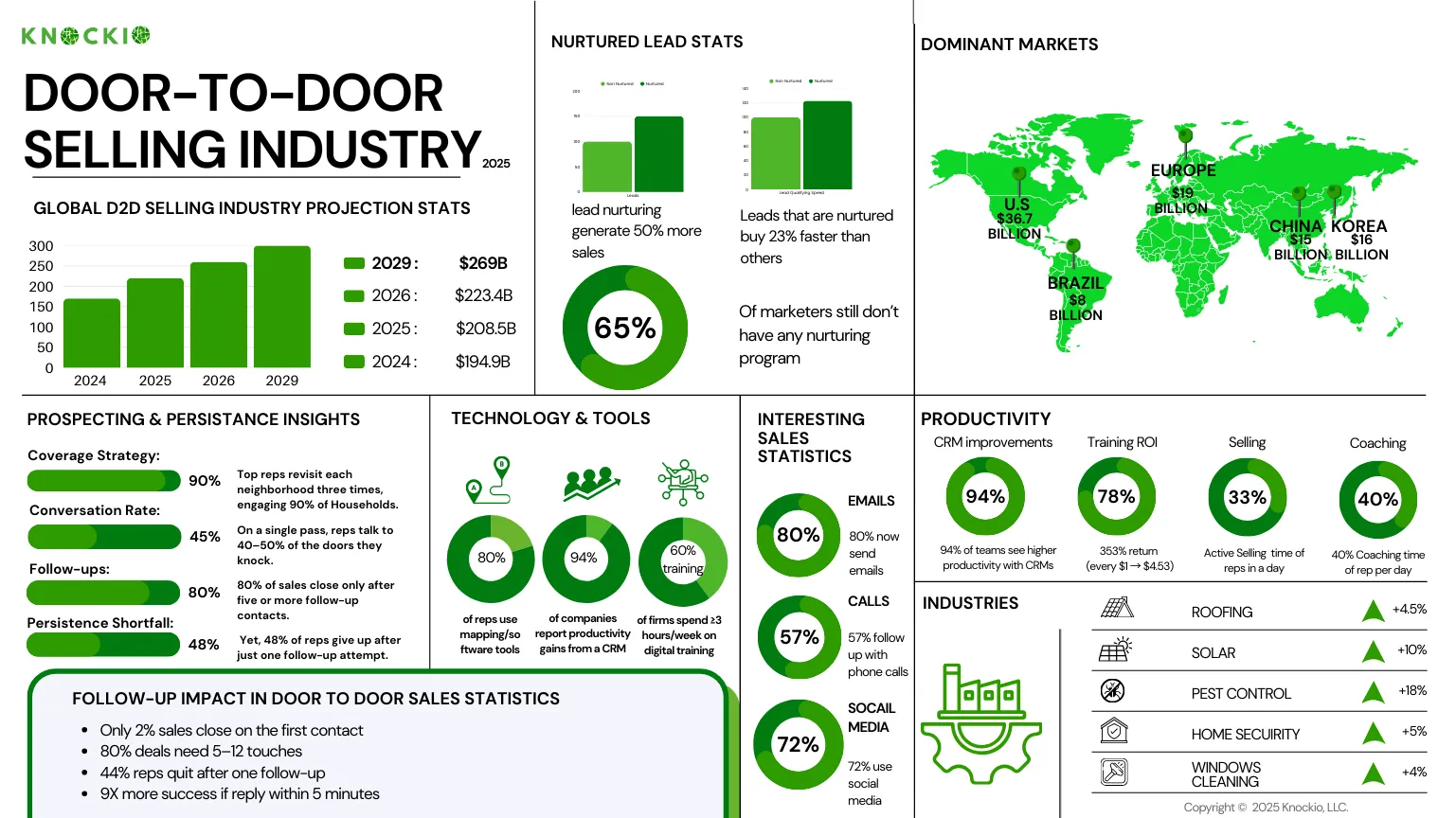
Door to door selling is far from dead. It is a market worth well over $150 billion a year, and it has held steady even through years that hurt most other industries.
According to the World Federation of Direct Selling Associations, global direct selling retail sales came in at roughly $163.9 billion in 2024, essentially flat compared to the year before but still above pre pandemic levels. Nearly half of the markets tracked by WFDSA actually grew that year. More than 104 million people work as independent direct sellers worldwide, and 72 percent of them are women. Twenty one countries now count as billion dollar markets, and together they make up over 90 percent of global sales.
Zoom out to the wider direct selling and door to door market, and the growth story gets even stronger. Analysts at The Business Research Company put the global direct selling market at roughly $207 billion in 2025, growing to about $220 billion in 2026, a 6.4 percent annual growth rate. Their forecast has the market crossing $280 billion by 2030, driven largely by AI powered sales tools, mobile commerce, and companies personalizing the door knock instead of guessing which houses to hit. You can dig into the full breakdown in this market report.
The takeaway for a home service business owner is simple. This is not a shrinking channel. It is a channel that is getting smarter.
With Knockio
The companies pulling ahead in a growing but competitive market are the ones who know exactly where their reps have been and what happened at every door. Knockio gives managers map based territory visibility, so they can see which streets are covered, which reps need backup, and which areas are being worked twice for no reason. When a homeowner says yes, that address does not just become a name on a list. It becomes a job in Knockio, carrying the address, notes, photos, and every appointment tied to it from the very first knock.
The US Door to Door Sales Market
The United States remains the single largest direct selling market in the world. According to WFDSA, the US generated about $34.7 billion in direct selling sales in 2024, a slight pullback from the year before, but still the top market globally by a wide margin.
This is not a business built only on makeup and kitchenware anymore. It covers roofing, solar, pest control, security, internet service, lawn care, and dozens of other home service categories. Flexible hours and uncapped commission still pull in a mix of college students, retirees, and people who simply do not want a desk job.
What has changed is the process. A rep today might see a Facebook post about a storm, message a homeowner about it, then knock the next day to follow up in person. That blend of digital outreach and face to face conversation is what kept US door to door sales strong through the pandemic years and it is still the playbook companies use now.
With Knockio
When a homeowner says yes at the door, that moment should not live only in a rep’s head or a paper notepad. In Knockio, a job carries the homeowner’s information, the address, notes from the conversation, any photos taken on site, and a status that tells the whole team exactly where that job stands. Nothing gets lost between the knock and the appointment.
Major Players and the Industries Still Knocking
Door to door selling is not run by one company. It is a method used across dozens of industries.
Amway, based in Michigan, is often called the largest direct seller in the world, generating around $8 billion a year. Avon, Mary Kay, and Herbalife built massive sales forces the same way, person to person, often starting at someone’s front door.
Outside of the classic direct selling brands, seven industries still lean on door knocking more than any others: cable and phone plans, solar panels, gas and electricity, home security, lawn and garden care, home repair, and multi level marketing products. Home improvement and telecom bring in the most revenue of the group.
Roofing is one of the clearest examples. After a hailstorm, it is common to see multiple roofing crews working the same neighborhood within days, offering free inspections for storm damage. One Minnesota homeowner reported nine different roofers knocking on his door after a single storm. That kind of competition is exactly why speed and organization matter so much for a canvassing team.
Pest control tells a similar story. Door to door pest control sales grew from about $200 million in 2015 to more than $1 billion by 2022. Orkin and Terminix still run door knocking teams to sign homeowners up for annual plans.
Home security followed the same path. Vivint Smart Home built its customer base almost entirely through door knocking teams, signing up more than 3 million US customers and paying roughly $300 million in commissions to its reps in 2022 alone. The company was eventually acquired for $2.8 billion, proof that a well run door to door sales operation can build serious enterprise value.
With Knockio
Every one of these industries runs into the same operational problem once the knock turns into a sale. The job has to move from the doorstep to the office to the crew without anything falling through the cracks. Knockio’s dynamic job statuses let a roofing, solar, pest control, or security company build a board that matches exactly how their team works, from lead to inspection to signed estimate to scheduled crew to invoice. Board view shows every job at its current stage, so a sales manager and a production manager can look at the same board and both understand exactly where things stand.
Technology in Door to Door Sales
The heart of door to door selling has not changed. It is still a face to face conversation. What has changed is how reps prepare for that conversation and what they carry into it.
Instead of knocking on every door on a street, teams now use data and mapping tools to target the houses most likely to say yes. Route planning apps cut down on wasted driving time. Mobile sales software lets reps log a lead, build an estimate, and collect a signature without ever pulling out a paper form. Many reps now close a sale on the spot, tablet in hand, before they walk to the next house.
Communication has changed too. Managers send live updates through group chats and sales apps. Roofing and solar teams sometimes use drones or satellite imagery to check a roof before they ever knock. At the same time, reps build early trust online, posting in local Facebook groups or Nextdoor before showing up in person to follow up with people who already engaged.
Smart doorbells like Ring and Nest have added a new wrinkle. Homeowners can see who is at the door before they answer, which means reps need to look and act more professional than ever. Clear company badges, appointment scheduling, and a straightforward introduction all matter more in a world where every visit might be recorded.
With Knockio
This is where Knockio’s Automation Flow Builder earns its keep. Once a rep captures a lead in the field, Knockio can automatically trigger a follow up text, schedule a callback task for a manager, or send an appointment reminder, all without anyone in the office lifting a finger. Live rep tracking gives managers real time visibility into where the team is working, which streets have been covered, and which reps might need support mid shift. This is not about watching people. It is about protecting the day. A manager who can see a rep stuck in a weak area can redirect them before the whole shift is wasted.
Challenges Reps Still Face
Knocking on doors has never been easy, and it is not getting easier.
In one UK survey, 82 percent of people said they dislike doorstep selling in any form. Scam calls and phishing attempts have made people more suspicious of strangers in general, which means a rep now has to earn trust before they can even start talking about the product. Busy two income households, “No Soliciting” signs, and local permit requirements all add friction. Some towns have outright bans on commercial door knocking, known as Green River Ordinances in the US.
The physical and emotional toll is real too. Reps walk for hours in all kinds of weather, hear “no” far more often than “yes,” and many quit within their first few months because of it. Safety matters as well. Companies often require reps to check in through an app or work certain areas in pairs.
Health concerns from the pandemic years still linger for some homeowners, even years later. The companies that have handled this well are the ones who stayed transparent: showing ID clearly, respecting posted signs, and training reps to handle rejection calmly instead of pushing harder.
None of this makes the job easy. It does explain why the reps and companies who master it still see it as one of the most direct paths to real, fast revenue in home services.
With Knockio
A lot of the friction in door to door sales comes down to lack of information. A rep who does not know a homeowner was already visited last week, or a manager who cannot tell which areas have already been worked, ends up wasting time and annoying homeowners. Knockio’s territory and job history tools solve that. Every past visit, note, and outcome tied to an address is visible to the team, so reps show up prepared instead of guessing.
Door to Door and Direct Sales Statistics
The US remains the top door to door and direct selling market in the world, followed by China, South Korea, and Brazil, with Europe close behind. Together these regions make up the bulk of a global direct selling market now valued at roughly $207 billion, on pace to top $280 billion by 2030 according to The Business Research Company.
Below is a breakdown of statistics across the sales methods that home service teams actually use day to day, from inside sales to field canvassing to referrals and follow ups.
Inside Sales Teams
Inside sales now accounts for close to 40 percent of deals, up from just 10 percent in 2017. Inside reps can reach roughly four times as many prospects at about half the cost of field teams, and the vendor who responds to a lead first wins 35 to 50 percent of the time. Even so, inside reps spend only about a third of their day actually selling, with the rest eaten up by admin work and contact research. (McKinsey; Salesroom State of Sales; CSO Insights; Inside Sales)
Field Sales
Field sales is not going anywhere, but it is blending with digital outreach. Most companies now run a hybrid model that mixes video calls with traditional in person visits, and hybrid teams see about 50 percent more revenue growth than teams that are purely digital or purely field based. This hybrid approach also widens the hiring pool, since reps are no longer limited to a single service area for prospecting work. (Forrester; McKinsey)
Prospecting
Forty two percent of reps say prospecting is the hardest part of their job. Most prospects still say they prefer an initial email, while over half of executives still favor a phone call first. In person events remain surprisingly strong, generating about a third of all leads. Most deals need five or more follow up touches to close, yet the majority of reps give up after only four attempts. (HubSpot; Rain Group; Gartner via Qwilr; Close.com)
Cold Calling
Cold calling is still alive. About 27 percent of reps say phone outreach works well for them, even though only 2 percent of calls turn directly into a meeting. It typically takes eight dial attempts to reach a prospect and closer to eighteen to build a real connection. Nearly half of reps give up after one call, despite data showing that extra follow ups can boost conversions by up to 70 percent. (Zendesk; Leap Job; CallHippo; Ringlead; Close.com)
Social Selling
Reps who use a real LinkedIn strategy are about 51 percent more likely to hit quota, and most organizations that invest in social selling see measurable revenue growth from it. Three out of four B2B buyers now research vendors on social media before ever talking to a rep. (LinkedIn; Resamaze; Phoenix Consulting; HubSpot)
Referrals
Referrals convert better than almost any other channel. Over 90 percent of consumers trust a recommendation from a friend or family member, referred customers spend more, and companies with a formal referral program grow revenue significantly faster than companies without one. Yet only about 30 percent of businesses actually run a structured referral program. (DemandSage; TrueList; Exploding Topics; WinSavvy)
Email
Email marketing still delivers one of the best returns of any channel, generating roughly $36 for every $1 spent. With around 20 percent average open rates and most opens now happening on mobile first, a short, specific subject line matters more than ever. Personalized subject lines can boost open rates by as much as 50 percent. (HubSpot; Oberlo; The Loop Marketing)
Follow Ups
Only about 2 percent of sales close on the very first contact. Most deals need somewhere between five and twelve touches, yet a large share of reps give up after just one attempt. Responding within five minutes of a new lead can boost engagement nearly ninefold compared to waiting even a little longer. (GrowthList; Peak Sales Recruiting)
Closing Rates
On average, only about one in five opportunities actually turns into a closed deal, with software companies closing slightly better than most other industries. Sales cycles have also been stretching longer in recent years, which is part of why nearly a third of field sales leaders say closing deals feels harder now than it did a year ago. (HubSpot; Tomasz Tunguz; SPOTIO’s 2025 State of Field Sales report; WebStrategies Inc)
Lead Nurturing
Nurtured leads produce about 20 percent more sales opportunities at roughly a third lower cost, and they move through the pipeline noticeably faster than leads left alone. Companies using marketing automation for nurturing have reported jumps of over 400 percent in qualified leads. Even so, most marketers still do not have a formal nurturing process in place, which is a real gap most competitors are not closing. (HubSpot; BeBusinessed; Ascend2; DemandGen; Forrester; Annuitas Group; Marketo)
Lead Quality
Nearly half of B2B companies say generating enough leads is their biggest challenge, but the deeper issue is often quality, not quantity. Fewer than 40 percent of companies consistently score and qualify their leads before handing them to sales. Response speed matters enormously here too: waiting even ten minutes to respond to a new lead can cut your odds of qualifying it by roughly four times compared to responding in five. (Sopro; MarketingSherpa; DecisionTree; Gleanster; Harvard Business Review; HubSpot)
Outbound Sales
Outbound still works. Roughly two thirds of buyers say they will take a cold call. Persistence is still the differentiator: most deals need at least five follow ups, but nearly half of reps quit after the first try. Companies that align their sales and marketing teams see meaningfully higher customer retention and win rates as a result. (HubSpot; Sales Insights Lab; DemandGen; Salesloft; RAIN Group; Marketo)
Inbound Marketing
Fifty nine percent of marketers say inbound produces higher quality leads than outbound. Most B2B buyers now do the majority of their research online before ever speaking to a sales rep, and companies that align their sales and marketing content see stronger revenue outcomes as a result. (HubSpot; Salesforce State of Sales; DemandGen Report; Content Marketing Institute; Edelman Trust Barometer)
More Data Behind the Numbers
B2B Buyer Behavior
A typical B2B purchase involves around seven people in the decision. Buyers now do the majority of their research online before ever talking to a sales rep, reviewing several vendor websites along the way. Most senior decision makers use social media to inform their choices, and referrals still play an outsized role in who gets the first meeting. (Gartner; Worldwide Business Research; Digital Commerce 360; B2B PR Sense; Harvard Business Review; McKinsey)
Productivity and Technology
Sales reps still spend less than a third of their day on actual selling, with the rest lost to admin work and logistics. Nearly half of managers say holding field teams accountable is a real struggle. That said, top performing teams use sales technology roughly three times more often than average teams, and AI powered automation is expected to cut manual admin work dramatically over the next few years. (Salesforce State of Sales; Alore.io; Teal; EBSTA B2B Benchmark; SPOTIO; Learn to Win)
Training and Coaching
Companies that invest in ongoing coaching see real results. Every dollar spent on training has been shown to return over $4 in value, and consistent coaching can boost a rep’s net sales by roughly 50 percent. Without regular refreshers, most training is forgotten within weeks, which is why high growth companies lean toward shorter, more frequent coaching over one time onboarding. (Qwilr; Salesloft; SalesBlink; Mailshake; Salesforce)
What Top Performers Have in Common
Top reps consistently use collaborative language, asking about a buyer’s goals instead of jumping straight into a pitch. They also bounce back from rejection faster than average performers, even when their raw skill level is similar. Persistence remains the clearest pattern: most closed deals needed five or more follow ups, and many buyers say “no” several times before finally saying “yes.” (Slack; HubSpot; Spekit; Salesgenie)
CRM Adoption
Businesses that adopt a CRM report meaningfully higher productivity, better forecast accuracy, and more sales overall. Most companies now run their CRM in the cloud, and the vast majority of sales leaders expect AI to play a bigger role in how their CRM works within the next couple of years. (Flowlu; Nutshell; RevOpsTeam; Email Vendor Selection)
Door to Door Specific Numbers
Even with every other channel in the mix, face to face knocking still converts at a real rate: 2 to 3 percent of knocks turn into a lead, and top performers who canvass an area three separate times can reach around 90 percent of homes in it. That usually works out to roughly one lead for every 50 doors knocked. Success in this channel still comes down to the same three things it always has: persistence, genuine rapport, and knowing which doors are worth knocking in the first place. (Zety; Sunbase; Grand View Research)
With Knockio
Numbers like these are exactly why territory planning and rep tracking matter so much. A team that can see coverage data in real time can push a rep back into a weak area or pull them out of an oversaturated one before the day is wasted. Knockio’s map view, territory assignment, and activity history give managers the information they need to turn raw knock counts into a real, repeatable strategy instead of guesswork.
What Comes Next for Door to Door Sales
E commerce and digital ads are not making the knock obsolete. Most industry analysts expect the opposite: door to door selling is becoming more targeted, not less relevant. Personal trust still closes home service jobs faster than any ad campaign, and that is not likely to change soon.
What is changing is the order of operations. More companies are moving toward a model where a homeowner fills out an online form or interacts on social media first, and the knock becomes a warm follow up instead of a cold introduction. That single shift makes the whole visit friendlier and more productive for everyone involved.
Roofing is a strong example of where this is headed. Roof related repair and replacement spending in the US hit nearly $31 billion in 2024, up roughly 30 percent since 2022, driven by storm activity and tightening insurance requirements on older roofs. With more than 101,000 roofing companies now operating across the country, competition for every homeowner’s attention has never been higher. That is exactly the kind of market where organized, well tracked canvassing beats a scattershot approach.
Direct selling as a whole is following the same pattern: global sales are forecast to climb from around $207 billion in 2025 to over $280 billion by 2029, according to The Business Research Company. The channel is not shrinking. It is getting sharper, more digital, and more competitive, which means the companies with the best systems behind their reps are the ones who will win the most jobs.
If your team is still juggling a canvassing app, a separate CRM, a scheduling tool, and a spreadsheet for invoices, that is exactly the kind of setup Knockio was built to replace. One system for rep tracking, job management, estimates, work orders, and payments means nothing gets lost between the first knock and the final payment.
Sources:
Global direct selling market (2024 figures, rep counts, billion-dollar markets)
Waqar Hussain leads SEO and digital media at Knockio, a field sales and field service management (FSM) platform for businesses managing sales reps, field teams, jobs, and customer appointments. He focuses on content strategy, search growth, and digital media to help more teams discover better ways to manage leads, jobs, and field operations.
Running a plumbing business is never just about fixing leaks and running new pipe. It is about running an entire operation at once. Your crew, your cash flow, your trucks, your parts inventory, and the customers who expect all of it to work without a hiccup.
When those pieces move together, a small shop turns into a company that owners can actually plan around instead of just survive week to week.
This guide covers the systems that make that shift happen. Scheduling, money, inventory, people, growth, marketing, and the technology that ties it all together. Along the way, we will show how Knockio’s plumbing service software handles the parts that usually eat up an owner’s whole morning: dispatch, invoicing, and keeping every job update in one place instead of five apps and a sticky note.
Why Plumbing Business Management Matters
Plumbing demand is strong almost everywhere, which also means the competition for customers is strong. People comparing plumbers are looking at price, speed, and how clearly you communicate. The company that manages the back office well usually wins that comparison, even if the actual pipe work is identical.
Weak management tends to show up as:
Missed appointments
Frustrated customers who called twice for the same issue
Costs that creep up without anyone noticing
Techs who quit because the day feels disorganized
Cash flow that swings unpredictably month to month
Strong management looks almost boring by comparison. Jobs start on time. Techs know exactly where to be. Invoices go out fast and get paid faster. Profit stops being a surprise at the end of the quarter.
1. Building Scheduling and Dispatch Systems That Actually Hold Up
Bad scheduling costs a plumbing business in ways that are easy to miss day to day. A tech drives across town for one job, then drives back for another ten minutes from where they started. A double booked slot turns into an apology call. None of that shows up as a single big loss, but it adds up fast in fuel, wasted hours, and irritated customers.
Smart Scheduling Practices
Group jobs by location. Clustering work in the same neighborhood or route means more time on tools and less time behind the wheel. Fuel costs drop and techs get through more stops per day.
Put urgent jobs first. A burst pipe cannot wait behind a routine fixture install. Triaging by urgency keeps small emergencies from turning into insurance claims.
Spread the workload evenly. One tech buried in calls while another has a light day is a scheduling problem, not a staffing problem. Balancing the board keeps the whole crew fresh.
Real Time Dispatch Control
The best plumbing operations do not build a schedule once in the morning and hope it holds. They adjust it live, because emergency calls do not wait for a convenient gap in the calendar.
With Knockio, dispatchers work from map view to see exactly where every tech is, then assign the closest available person to a new job in a few taps. If a job runs long or a tech calls in sick, the schedule can shift in real time instead of falling apart. Every reassignment updates the job record automatically, so nobody is chasing down who is supposed to be where.
That kind of visibility turns a chaotic morning into a manageable one. Dispatchers stop guessing and start directing.
2. Mastering Financial Management
A plumbing business can be fully booked and still be losing money. That usually comes down to three things: costs creeping up unnoticed, invoices going out late, and nobody tracking where the dollars are actually going.
Key Practices for Financial Control
Track cost per job. Labor, materials, and fuel all need to be counted against each job, not just estimated in your head. Without that number, pricing is a guess.
Watch how fast invoices get paid. A pile of unpaid invoices is a cash flow problem hiding as a sales success.
Break spending into categories. Fuel, tools, payroll, admin, and marketing each deserve their own line so you know where the money actually goes.
Bill the same day the job finishes. Every day between job completion and invoice sent is a day payment gets pushed further out.
Using Digital Tools Instead of Paper and Spreadsheets
Paper invoices and scattered spreadsheets slow down the exact moment when speed matters most: getting paid.
Inside Knockio, an invoice can be created the moment a job wraps up, pulled straight from the job record with the labor, materials, and any change orders already attached. Once it is sent, your team can collect payment through text to pay, tap to pay, credit card, or ACH, or log a manual payment for a customer who pays by check. Either way, the job stays updated with its payment status, so the office is not chasing down which invoices are actually settled.
3. Managing Inventory and Tools
Inventory management is really just knowing three things at all times: what you have, what is running low, and whether it will be ready when a tech needs it on the truck.
Inventory Best Practices
Organize supplies by category and use. Grouping parts logically means less time hunting for a fitting and more time on the job.
Set reorder points. A minimum stock threshold means you reorder before you run out, not after a tech calls in stuck.
Audit on a regular schedule. Regular counts catch shrinkage, loss, or miscounts before they become a real financial hit.
Knockio’s product and inventory tools let you track parts by SKU, set cost and markup per item, and get low stock alerts before a shortage stalls a job. Material takeoffs can be linked straight to inventory, so what gets planned for a job matches what actually gets pulled from stock, and purchase order receiving keeps your counts accurate as new shipments come in.
When parts are on the truck and ready to go, techs finish more jobs per day, and customers do not hear “we’ll have to come back for that part.”
4. Hiring, Training, and Retaining Technicians
A plumbing business is only as strong as the people showing up to do the work. Hiring well, training properly, and keeping good people around matters more than almost anything else on this list.
Recruiting Smart
Screen for both technical skill and how someone talks to customers. A great plumber who alienates homeowners still costs you repeat business.
Use a trial job or working interview to see real performance, not just a resume.
Show new hires a real path forward in the company, not just a job title.
Training and Retention
Good training covers more than pipe work. It includes learning the software your team runs on, communicating clearly with customers, and handling invoicing in the field without slowing down the job.
Techs who feel invested in tend to stay. That investment shows up as performance bonuses, recognition for good work, and ongoing education that helps them handle harder jobs with confidence.
5. Scaling Operations: When and How
Every plumbing business eventually asks the same question: is it time to grow? Grow too soon and you strain your crew and your cash. Wait too long and a competitor picks up the jobs you were not ready to take.
Signs You Are Ready to Expand
You are turning away more work than you can take on
Your crew is booked out weeks in advance
Your current operations run smoothly enough to hand off to someone new without chaos
Smart Expansion Strategies
Document your processes clearly enough that a new hire can follow them without hand holding
Grow into nearby areas first instead of jumping across the map
Put a supervisor in place before the team gets too big to manage directly
Growth only works if the systems underneath it can handle more volume. A business that is disorganized at ten jobs a week will be more disorganized at thirty.
6. Marketing and Customer Retention
Marketing brings customers in the door. Retention is what keeps them calling you back instead of searching for someone new next time a pipe breaks. In plumbing, word of mouth from happy customers often does more work than any ad campaign.
Marketing Tactics That Work
Local SEO. An optimized Google Business Profile is what shows up when someone searches “plumber near me” at 11pm with a leak.
Customer reviews. Ask satisfied customers to leave one. It is the cheapest, most trusted marketing you have.
Targeted local ads. Google and Facebook campaigns aimed at your service area bring in the right kind of attention.
Maintenance packages. Annual inspection contracts create predictable, recurring income instead of relying only on emergency calls.
Customer Retention Strategies
Offer loyalty discounts for repeat customers
Send reminders ahead of seasonal maintenance
Follow up with a thank you message after every completed job
A loyal customer base saves money on acquisition and does a lot of your marketing for you simply by recommending you to neighbors and friends.
7. Using Technology to Stay in Control
Technology in a plumbing business is not about adding another app to check. It is about cutting the number of places information can go missing.
Why Software Matters
Less manual paperwork means fewer errors and less time spent on admin
Customer information lives in one place instead of scattered notebooks and phones
Owners and managers can see what is happening across the business without calling every tech individually
Reports and analytics turn gut feeling into actual decisions
How Knockio Fits Into Plumbing Operations
Knockio was built for field service companies that are tired of stitching together five or ten different tools. Inside one platform, a plumbing business can run:
Job scheduling and routing, so dispatchers can plan routes, cut drive time, and handle same day emergencies without starting from scratch
Customer and job history tracking, storing contacts, notes, photos, files, and full activity history against every job
On site estimates and digital contracts, letting techs build a quote in the field, add optional line items, and capture a customer’s digital signature on the spot
Photo and document attachments, so completed job photos, permits, and instructions stay attached to the work order instead of buried in a text thread
Role based permissions, controlling who on your team can see financial data, customer details, or sensitive job information
The result is fewer places for information to get lost, and fewer tools your office staff has to log into just to answer one customer question.
8. Monitoring Performance With Analytics
Analytics tell you what is actually working, not what feels like it is working. Reports and dashboards let you track response times, job status, customer feedback, and profit margins in one view instead of piecing it together from memory.
Key Metrics Worth Watching
First time fix rate. The percentage of jobs solved in a single visit. A low number often points to a training gap or a parts availability problem.
Utilization rate. How much of a tech’s day is billable work versus driving.
Customer response time. The gap between booking and actual service.
Job profitability. Margin by job type, so you know which services are actually worth prioritizing.
When a metric slips, it usually points straight to the fix. Low first time fix rates often mean a tech needs more training or the truck needs better stocked inventory.
9. Risk, Safety, and Compliance
Safety and compliance are not paperwork for its own sake. They protect your crew, your customers, and the reputation you have spent years building.
Best Practices
Run safety training regularly, not just once during onboarding
Keep licenses and permits current at all times
Review and update insurance coverage on schedule
Document warranties clearly and handle customer claims fairly
Staying ahead of risk means fewer surprises. A business that plans for problems before they happen tends to stay steady when something does go wrong.
10. Building a Long Term Strategy
A long term plan gives your plumbing business direction instead of leaving growth to chance. It means deciding now where you want the business in five or ten years, and working backward from there.
Strategic Areas to Consider
Technology upgrades. Choose tools that work well with what you already have in place, not tools that force a rebuild.
Succession planning. Decide early how the business continues if you step back.
Diversification. Consider adding services like HVAC or water treatment once your core plumbing operations are stable.
Brand building. Position your company as the trusted name in your service area, not just another number in a search result.
Covering these areas keeps a business organized today and ready for whatever comes next.
Final Thoughts
A successful plumbing business is not built overnight. It comes from steady attention to people, systems, and customers, repeated day after day.
The businesses that grow and last tend to share the same handful of habits:
Scheduling and dispatch that actually holds up under pressure
Financial controls that catch problems early
Inventory systems that keep techs stocked and moving
A crew that is trained well and sticks around
Marketing and retention that turns customers into repeat business
Software like Knockio that replaces five or ten disconnected tools with one connected system
If you want your plumbing business to grow and last, focus on what actually matters: your people, your systems, and the customers who keep calling you back. Keep improving in small steps, stay open to learning, and build trust one job at a time.
Written by
Waqar Hussain
SEO & Digital Media Manager at Knockio
Waqar Hussain leads SEO and digital media at Knockio, a field sales and field service management (FSM) platform for businesses managing sales reps, field teams, jobs, and customer appointments. He focuses on content strategy, search growth, and digital media to help more teams discover better ways to manage leads, jobs, and field operations.
Pests cause real damage to health, property, and reputation, and that’s exactly why pest control keeps growing into a business people trust with real money. Cities keep expanding, homeowners care more about hygiene than they used to, and commercial buildings need pest compliance just to stay open. Industry forecasts put the global pest control market past $30 billion by 2030. That kind of demand gives a new operator real room to build something that holds up even when the broader economy doesn’t.
Whether you’re a licensed technician ready to run your own crew or a first time entrepreneur looking for a business that doesn’t depend on trends, learning how to start a pest control business is a solid move. You don’t need a massive war chest to begin. You need the right license, a clear plan, and a system that keeps your jobs, your team, and your money organized from day one.
Understanding the Pest Control Industry Landscape
Before you spend a dollar on equipment or a license exam, it helps to understand how the industry actually works. That understanding shapes which services you offer, who you sell to, and how you price.
Key Pest Control Services in Demand
Not every pest control service gets called for at the same rate. Some pay better. Some are seasonal. Some require extra licensing but reward you with steadier income once you have it.
Residential pest control: Ants, roaches, bed bugs, and rodents are constant problems for homeowners, which makes this the volume play for most new companies.
Commercial pest control: Restaurants, offices, and warehouses need pest management to stay compliant and keep inspections clean. Contracts here tend to run longer.
Termite work: Many states require special licensing for this, but termite jobs pay well and often turn into annual inspection contracts.
Bed bug control: Heat treatments and residual treatments both require a clear protocol and a real follow up plan, since one missed step can mean a callback.
Mosquito control: This service spikes hard in warm months, so it works well as a recurring monthly plan rather than a one time job.
Wildlife exclusion: Sealing entry points, setting traps, and giving sanitation advice. It pairs naturally with rodent control and tends to carry better margins because fewer companies do it well.
Eco friendly and organic pest solutions: More homeowners want treatments that are safe around kids and pets, and this niche keeps growing as awareness grows with it.
Common Challenges Faced by Pest Control Startups
Every new pest control company runs into the same handful of obstacles early on. None of them are fatal if you plan for them.
Getting through licensing requirements before you can legally work.
Staying current on chemical safety and environmental regulations.
Competing for visibility against companies that have been around for years.
Managing seasonal swings in demand without a recurring revenue base to fall back on.
Companies that plan around these challenges from the start, instead of reacting to them later, build a stronger brand faster than the competition.
Creating a Business Plan for Your Pest Control Company
A real business plan is what turns “I want to start a pest control company” into a working business. It gives you a roadmap: where you’re headed, how you’ll get there, and what you’ll need along the way.
Setting Business Goals and Objectives
Clear goals keep you focused when the early months get chaotic. Start with small, realistic targets, then build toward where you want the business to be in a few years.
A few examples worth borrowing:
Serve 50 residential clients in your first 6 months.
Reach $100,000 in revenue by the end of year one.
Identifying Your Target Market and Service Niche
Different customers need different things. A busy homeowner wants speed. A restaurant manager wants documentation. A property manager wants predictable, recurring service. Knowing who you’re serving shapes everything from your pricing to your marketing.
You’ll generally choose between:
Residential clients: Higher volume, lower ticket value per job.
Commercial clients: Fewer accounts, but bigger contracts and more consistent revenue.
Eco friendly solutions: A premium niche with strong, growing demand.
Legal Requirements and Licensing for Pest Control Businesses
You’re handling chemicals and sometimes wildlife, so the legal side isn’t optional. Getting licensed properly protects you and tells your clients you’re a professional, not a side hustle with a spray bottle.
Getting Certified and Licensed
Every U.S. state requires a commercial pesticide applicator’s license for pest control operators, typically issued through the state’s Department of Agriculture or Environmental Protection office. The exam usually covers pest identification, safe pesticide handling, and environmental impact.
Understanding Health and Safety Regulations
Chemicals, traps, and wildlife mean safety has to come first, every time. Your team should follow OSHA standards and EPA rules for handling chemicals. Keep clean records and use proper protective gear. It keeps your people safe and shows clients you take the work seriously.
Choosing a Business Structure and Registering Your Company
Your business structure affects your taxes, your liability, and how you run day to day operations, so it’s worth getting right early.
Sole Proprietorship: Easiest to set up, but you’re personally on the hook for business debts.
LLC: Protects your personal assets while staying relatively simple to manage.
Corporation: More paperwork, but stronger liability protection and easier access to funding down the line.
Once you’ve picked a structure, register your business name, apply for an EIN, and pull any local permits you need to operate legally.
Building Your Pest Control Brand Identity
Your brand is what people remember after the truck pulls away. It’s built from your name, your logo, your message, and how consistent all of it feels.
Designing an Effective Logo and Brand Message
A clean logo signals professionalism before a customer ever talks to you. Your message should make it obvious what you stand for. Keep the design simple, and consider a tagline that gives people a quick read on your business, something like “Protecting Homes, One Pest at a Time.”
Building a Professional Website and Online Presence
Most people searching for pest control start online, so your website needs to do real work for you. It should let visitors see your services, check pricing, and contact you without friction. Beyond the website, an active presence on review sites and social media builds trust before the first phone call.
Your site should include:
Service pages and pricing: Make it easy to see what you offer and what it costs.
Customer reviews: Real testimonials build trust faster than any ad copy.
Google Business Profile: This is how local customers find you when they search.
For a closer look at industry standards, PestWorld.org, the National Pest Management Association’s official site, is a useful reference point.
Purchasing Equipment, Chemicals, and Supplies
Good equipment is what separates a professional job from a sloppy one, and your customers notice the difference even if they can’t name it.
You’ll want to have on hand:
Sprayers, applicators, and sealants for accurate treatment placement.
Traps, glue boards, and bait stations for rodent and insect control.
Protective gear, including gloves, masks, and safety clothing.
Approved chemicals and pesticides matched to the pests you’re treating.
Inspection tools like flashlights, ladders, and moisture meters to spot activity.
Cleanup supplies so you leave every job site looking professional.
Showing up properly equipped, even on your first week of business, makes your company look established from day one.
Hiring and Training Your Team
Your team is what keeps the business running once you can’t be on every job yourself. Hiring well and training thoroughly protects your reputation and keeps customers coming back.
Hire the right people: Look for technicians who are reliable, detail oriented, and comfortable around both customers and chemicals. Recent U.S. labor data puts median pest control technician pay in the mid $40,000 range annually. Adjust that for your local market and competition.
Train thoroughly: Cover equipment use, pest identification, and customer service, not just the technical work.
Set clear procedures: Standardize your SOPs for inspections, treatments, and follow ups so quality doesn’t depend on which technician shows up.
Document everything: If it isn’t written down, it didn’t happen, and that matters for both training and liability.
Keep learning: Pest control techniques and products evolve, so build ongoing training into your operations.
Lead by example: The professionalism and safety standards you model become the standard your team follows.
Marketing Strategies to Grow Your Pest Control Business
Being great at pest control doesn’t matter if nobody knows your business exists. Smart marketing puts you in front of the right people consistently.
Build a professional website: Make your services, pricing, and contact information easy to find.
Optimize for local search: Claim your Google Business Profile and ask satisfied customers for reviews.
Use social media: Share before and after photos, quick tips, and real customer stories.
Offer promotions and referral programs: Seasonal deals and referral bonuses are reliable ways to bring in new business.
Network locally: Property managers, real estate agents, and local businesses are strong referral sources.
Advertise strategically: Targeted online ads, local print, and community boards all still work when used well.
Setting Prices and Managing Finances
Running a pest control company means treating pests and running a profitable business at the same time. Smart pricing and tight financial tracking are what keep the lights on.
Research the local competition: Check what other companies in your area charge and price your work to reflect your expertise.
Account for every cost: Equipment, chemicals, labor, insurance, and overhead all need to be in your pricing math. Most pest control companies run around a 15 to 25 percent profit margin depending on services and territory. A simple break even calculation tells you how many clients you need monthly to stay profitable.
Offer flexible service packages: Monthly, quarterly, and yearly plans create steady, predictable income.
Provide options for every budget: A range from basic to premium plans widens who you can sell to.
Stay organized: Track expenses, invoices, and payments with reliable software, keep a dedicated business bank account, and bring in a CPA for tax planning.
Track expenses carefully: A detailed record shows you exactly where money is going and where you can cut.
Monitor cash flow: Make sure incoming revenue covers payroll, bills, and the unexpected.
Plan for growth: Set aside funds for marketing, training, and equipment upgrades so expansion doesn’t strain the business.
Running Your Pest Control Business as One Connected System
A lot of new pest control owners start out juggling a spreadsheet for jobs, a separate app for invoicing, a paper calendar for routes, and a group chat for the crew. It works for the first few customers. It falls apart once you’re managing twenty jobs a week across multiple technicians.
This is where most companies start looking for software, and the right system does more than store contact information. It should follow a job from the first inspection all the way through payment.
Here’s what that looks like with Knockio. Once a job is created, it holds the customer’s information, the property address, notes from the inspection, photos from the technician, the chemicals used, the appointment history, and the invoice, all in one record instead of scattered across four tools. Dynamic job statuses let you build your own pipeline, so a job can move from “Inspection Scheduled” to “Treatment In Progress” to “Follow Up Due” using whatever names fit how your company actually works.
Map view shows your team where every job sits geographically, which matters a lot when you’re trying to keep routes tight and drive time low. Board view gives your office staff a clear picture of where every job stands in the pipeline, so nothing slips through during a busy week. List view gives you the detail when you need to dig into a specific account.
On the financial side, estimates can include optional line items, digital signatures, and customer acceptance, so a technician can quote a termite job on site and get it signed before they leave the property. Once work is approved, it can move into a work order with tasks, schedules, and crew notes attached, and payment can be collected through text to pay, tap to pay, credit card, or ACH, or entered manually if a customer pays by check. Recurring mosquito or quarterly pest plans can be set up once and then tracked automatically as jobs come due.
The Automation Flow Builder handles the repetitive follow up that’s easy to forget when you’re busy: payment reminders, appointment confirmations, and seasonal check in texts can all run without someone in the office manually sending them.
None of this replaces good technicians or good service. It just means the information about every job lives in one place instead of five different tools that don’t talk to each other.
Building Long-Term Customer Relationships
Customers who come back, refer friends, and leave reviews are worth far more than any single job. Building that kind of loyalty doesn’t take much, but it does take consistency.
Follow up after every visit: Confirm the treatment worked and answer any lingering questions.
Send seasonal reminders: Tips on stopping mosquitoes in summer or blocking rodents before winter keep you top of mind.
Offer small perks: Loyalty discounts and referral rewards show appreciation without cutting deep into margin.
Stay genuinely helpful: Prevention checklists and simple advice build trust beyond the service call.
Show up professionally: Arrive on time, wear a clean uniform, explain the plan, and leave the space neat.
Earn reviews honestly: Happy customers bring in new business at a lower cost than almost any ad campaign.
Scaling Your Pest Control Business for Growth
Once the core business runs smoothly, growth becomes the next real decision. A few practical paths:
Expand carefully: Add nearby suburbs only if your routes stay tight. Long drives quietly eat your profit.
Add in demand services: Bed bug heat treatments or termite inspections make sense once your team is trained and equipped.
Build a small commercial division: Restaurants, property managers, and warehouses respond well to strong documentation and clear communication.
Consider small acquisitions: Buying a nearby competitor can accelerate growth if you have the cash and a real integration plan.
Protect the fundamentals: Documentation, efficient routing, recurring plans, and a well trained team are what let growth actually stick.
Common Mistakes to Avoid When Starting a Pest Control Business
A few missteps show up again and again in new pest control companies, and most are avoidable with a little foresight.
Starting before licensing is approved: Working without proper licensing risks fines and damages trust before you’ve even built any.
Underpricing your services: A cheap job that requires a long drive and thin margin hurts your cash flow more than it helps your client count.
Ignoring safety standards: Label instructions and protective gear exist for a reason, every time, not just on inspection days.
Neglecting marketing: Great service means nothing if potential customers never hear about it.
Poor bookkeeping: Without a clear financial record, tax season and cash flow problems show up at the worst possible time.
Twelve Week Launch Plan
Weeks 1 and 2: Get Legal and Set Up Services
Pick 3 to 4 core services and write a one page process for each. Register for your state exams and gather study guides. Set up your business entity, insurance, and bank account. Buy essential gear and organize your safety binder.
Weeks 3 and 4: Branding and Online Presence
Finalize your business name and logo. Order uniforms and add vehicle lettering. Build a simple website with a home page, service pages, and locations. Add a clear “Book an Inspection” button. Set up your Google Business Profile and collect your first two or three reviews.
Weeks 5 and 6: Software and Territory Setup
Set up a platform like Knockio to handle your jobs, scheduling, and customer records before you’re too busy to do it properly. Plan your service areas and routes. Build estimate templates with digital signatures linked to your calendar. Set clear pricing tiers and add ons to keep quoting simple.
Weeks 7 and 8: Job Generation
Spread the word in 2 to 3 nearby ZIP codes. Run a small search ad campaign to build local visibility. Leave door hangers and ask happy customers to refer friends and family.
Weeks 9 and 10: Service Delivery and Documentation
Do every job carefully, with clean notes and photos attached to the record. Track drive time, chemical use, and any callbacks. Ask satisfied customers for reviews and permission to use their photos.
Weeks 11 and 12: Optimize and Grow
Adjust routes, appointment windows, and pricing based on what the first ten weeks taught you. Introduce a seasonal offer, like a mosquito plan, heading into the next quarter. Publish a few helpful articles that link back to your service pages.
Residential and Commercial Playbooks
Residential Clients
Be quick, friendly, and clear. Speed and easy communication matter more here than almost anything else. Leave a prevention checklist behind, since small tips leave a lasting impression. Book the next visit before you leave so the customer already knows what’s coming.
Commercial Clients
Stay professional, predictable, and thorough with documentation. Bring proof: reports, station maps, and training records build credibility fast. Use your software to standardize reports and chemical logs instead of relying on memory. Stay audit ready for sensitive sites like restaurants, with a clean record and clear response times.
Risk Management and Quality Control
Safety isn’t optional in this industry. It’s what protects your team, your customers, and your business from fines and accidents.
Follow the label: Stick to recommended application methods, doses, and re entry times every time.
Calibrate equipment: Check sprayers regularly to make sure they’re performing accurately.
Store products safely: Keep chemicals secured and log every use.
Track callbacks as data: A recurring pest complaint usually points to a training gap or a procedure that needs updating.
Prepare for emergencies: Keep a spill kit in every vehicle and emergency contacts saved in your app.
Learn from incidents: Bring problems up in weekly meetings so the whole team improves, not just the technician involved.
Financial Targets and Unit Economics
A handful of numbers tell you most of what you need to know about your business’s health.
Recurring revenue: Grow the share of income coming from monthly or yearly plans.
Material costs: Track what each service actually costs you in product.
Travel efficiency: Measure daily drive time against working time, then adjust routes for better margin.
Callbacks: Track callbacks per 100 jobs and work to lower that number through better inspections and training.
Margins: Raise prices for far zones, drop accounts that require long drives, and keep tightening your routes.
Cash flow: Annual prepay discounts can keep money coming in more predictably.
Dashboards: Simple, visible numbers in one place help you catch problems early instead of finding out at tax time.
Conclusion: Turning Your Pest Control Startup Into a Thriving Enterprise
Succeeding in pest control comes down to a working system and a few smart habits applied consistently.
Start simple. Pick a few core services, get properly licensed, buy the right gear, and write clear procedures. Use one connected system for documentation, sales, routing, and scheduling so nothing falls through the cracks. Focus on recurring plans and tighter routes to fit more stops into less time. Keep an eye on costs, callbacks, and travel so problems get caught early. Communicate clearly with customers and leave them with something useful after every visit.
When you’re ready to grow, expand carefully, keep your routes efficient, and keep your records clean. Steady demand, a system that actually works, and customers who trust you are what turn a new pest control company into a brand that keeps growing year after year.
Ready to run your jobs, scheduling, and payments from one place? see how Knockio’s pest control software connects your sales and service teams from the first inspection to the final invoice.
1. How much will it cost me to start a pest control business?
You will need to spend between $10,000 and $50,000. That includes licensing, equipment, and marketing. You can start small and grow as your business picks up.
2. Do I need a license to start?
Yes, you’ll need to pass exams on pesticide safety and regulations.
3. Is pest control actually profitable?
Definitely! Most pest control businesses earn around 15–25% in profit. If you want a consistent income, keep your eyes on recurring contracts; they keep your income consistent.
4. How do I get my first customer?
You should start looking in your community. You can claim your Google Business profile, ask friends or family for referrals, run a small ad, or leave door hangers. You can also try offering a first-time discount to help build trust and get those early reviews.
5. What’s the best software to manage my business?
You should look into tools like Knockio, Jobber, PestPac, and Housecall Pro to make life easier.
Written by
Waqar Hussain
SEO & Digital Media Manager at Knockio
Waqar Hussain leads SEO and digital media at Knockio, a field sales and field service management (FSM) platform for businesses managing sales reps, field teams, jobs, and customer appointments. He focuses on content strategy, search growth, and digital media to help more teams discover better ways to manage leads, jobs, and field operations.
Drive across the country and you start to notice something. A roof in Phoenix looks nothing like a roof in Buffalo. That is not an accident. What survives Arizona heat would crack under Minnesota snow. So every region settles into the roofing that fits its weather, its building styles, and the way people actually live there.
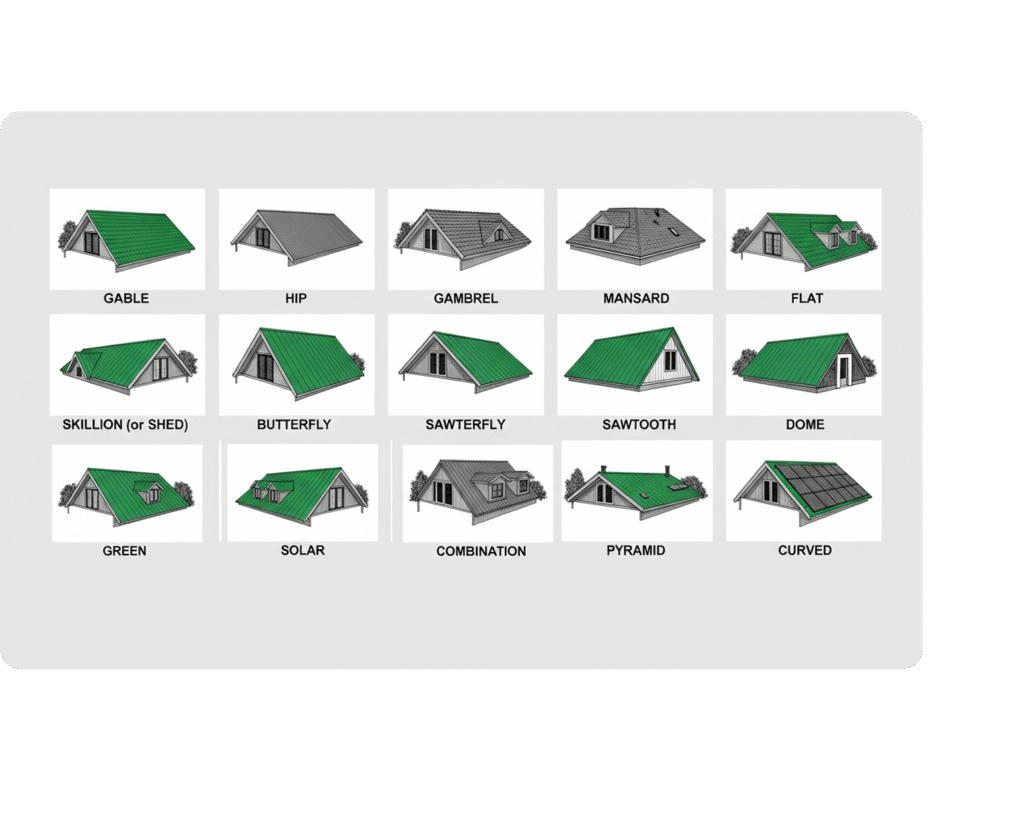
This guide walks through the fifteen most common roofing types you will see in the United States right now. For each one, you will get what it is, why a homeowner picks it, where it shows up most, and the small details that set it apart.
If you sell or install roofs for a living, there is something here for you too. Running a roofing business means juggling estimates, crews, payments, and follow ups across a lot of moving jobs. We will show where a platform like Knockio’s Roofing CRM Software helps roofing teams keep every job organized, from the first knock to the final payment, no matter what climate they work in.
Let’s get into it.
Here is a breakdown of the types of Roofing in the United States
1. Asphalt Shingle Roofing
Start with the clear leader. Asphalt shingles cover more American homes than anything else. You know the look. Overlapping strips that lay flat and clean across the roofline.
Three things keep them on top:
Price. They are the most affordable option a homeowner can buy.
Easy installs. Almost every crew knows how to work with them, so labor stays reasonable.
Color choices. They come in nearly every shade, so they fit most home styles and roof shapes.
Drive through Texas, Georgia, or the Midwest and you will spot asphalt on most suburban streets. In windier spots, crews add extra nails or a heavier adhesive so the shingles hold when storms roll through. These roofs are not built for extreme weather, but they handle moderate climates well and usually last 20 to 30 years. For most families, that mix of price and lifespan is hard to beat.
Asphalt jobs move fast, which is exactly why the office can lose track of them. A roofing company might run dozens at once. With Knockio, each asphalt job carries its own record: the homeowner’s address, contacts, photos from the inspection, the estimate, and a job status the whole team can see. When a job moves from sold to scheduled to installed, the status updates and everyone stays on the same page. No more guessing which roof got done last week.
Metal roofing plays a different game. Clean lines, modern look, and a lifespan that makes homeowners pause. You see it on houses and commercial buildings across the country, and the main draw is simple. It lasts a very long time.
Most metal roofs use aluminum, copper, or steel. They cost more up front, but a good one can run around fifty years with little fuss. They reflect heat, resist fire, and stand up to rough weather. In hurricane zones like Florida, they hold when the wind tries to peel everything off. In snowy states like Colorado, Minnesota, and Washington, they shed snow fast so ice does not pile up.
If looks matter, the standing seam style with its tall vertical lines is the favorite. It works on modern homes and that updated farmhouse style people love right now.
Metal roofs are bigger projects, which means more steps between the handshake and the install. This is where a connected job record earns its keep. In Knockio, a sold metal job turns into a work order with tasks, a crew schedule, and notes the installers can read on site. The material takeoff links to inventory, so the office knows what panels to order. When the job wraps, the same record holds the final photos and the invoice. One job, one timeline, no scattered spreadsheets.
3. Clay Tile Roofing
Walk through a neighborhood in California or Arizona and you will see those rounded, sun baked tiles. That is clay roofing. It thrives in hot, dry places because the tiles soak up heat without fading or breaking down. It carries that Mediterranean or Spanish look, and it does not burn, which matters a lot in wildfire country.
There is a catch. Clay is heavy, so the home needs strong framing, and installs cost more than asphalt or metal. Still, many homeowners decide it is worth it. Once those tiles are up, they can last decades, sometimes a full century. Near the Florida coast, clay and concrete tiles are everywhere because they handle heat and salty air better than most materials.
Clay is a premium sale, not a quick one. A homeowner spending this kind of money wants to see exactly what they are paying for. Knockio’s estimates handle that well. You can build a clear quote with optional line items, pull pricing from a product and service catalog, and let the homeowner accept and sign right on the spot with a digital signature. If they want to add a feature later, a change order keeps the numbers clean and the job record accurate.
4. Concrete Tile Roofing
Think of concrete tile as clay’s more flexible, slightly cheaper relative. You get that same architectural shape, but the tiles can be molded and colored to mimic wood shakes or slate. So a homeowner gets the look they want plus real durability. The downside is the same as clay. It is heavy, so the roof frame may need reinforcement to carry the load safely.
You will see concrete tile all over Nevada, Southern California, and Arizona. It holds up in heat, costs less than clay, and comes in plenty of colors and textures, which gives builders room to shape how a whole neighborhood looks.
Bigger tile projects often carry bigger price tags, and that means more paperwork. Knockio lets you turn an on site estimate into a signed agreement without driving back to the office. Use a saved template so you are not rebuilding the same quote every time, let the homeowner sign on your phone or tablet, and the accepted estimate becomes part of the job record automatically. The sale closes while you are still standing in the driveway.
5. Slate Roofing
Slate is the top shelf choice. Real stone, almost impossible to wear out, and stunning to look at. Care for it and a slate roof can hold strong for over a hundred years. Those deep gray and green tones give old homes their classic, vintage character.
Look for slate in the Northeast: New York, Vermont, and Pennsylvania. Plenty of older houses there still wear their original slate. The trade off is cost. The tiles are expensive, the install needs real expertise, and the home has to be strong enough to carry the weight. But for a historic home or a high end build, nothing else compares.
Slate projects can stretch over weeks and involve specialty crews. Keeping the job moving means everyone needs to see the same information. With Knockio’s board view, a company can watch each slate job move through its pipeline stage by stage, with the right people assigned at each step. Notes, files, and photos all live on the job, so a crew lead and the office never have to chase each other for updates.
Wood roofs have a charm that never really fades. Neat shingles or rougher, rustic shakes both add a natural warmth that is hard to copy. Cedar is the popular pick because it smells great and resists rot better than most woods. The catch is upkeep. Wood needs cleaning, treating, and the occasional swap to keep moss and fire risk in check.
You will find wood roofs in Washington, Montana, and Oregon, where the material is close by and people love that cozy, natural feel. Some old cottages along the Maine and Massachusetts coasts still wear wood too.
Selling wood means setting honest expectations about maintenance, or you get an unhappy customer two years later. Knockio helps you keep that conversation organized. Store the inspection photos, care guides, and product details right on the job, then set up automated reminders through the Automation Flow Builder so the homeowner gets a maintenance nudge when the season calls for it. That kind of follow up is what turns one wood roof into a referral.
7. Solar Tile Roofing
Solar tiles are the roofing world’s newest big idea. Instead of bolting bulky panels onto your shingles, the tiles themselves make electricity. The result looks clean and does two jobs at once: it protects the house and trims the power bill.
The up front cost gives people pause. But over time, lower electricity bills and tax incentives can add up to real savings. Solar tiles are catching on in California, Arizona, and Nevada, where the sun shows up most days and power costs run high. Some states even nudge homeowners toward solar through building codes.
For a roofing company, solar tile work can be a smart, profitable add. The challenge is helping a homeowner understand the long term math. With Knockio, you can build a detailed estimate that lays out the cost clearly, save it as a reusable template for your next solar lead, and capture the customer’s signature the moment they are ready. The whole money conversation stays grounded in a clean, professional quote instead of scribbled napkin math.
8. Composite or Synthetic Roofing
Composite roofing is the great pretender. It looks like a pricey material such as slate or wood, but it is made from recycled plastics, rubber, or polymer blends. These roofs are light, resist mold, and usually carry long warranties, which makes them an easy yes for a lot of homeowners.
You will see composite in Washington, Oregon, and California, where people care about sustainability and want something that lasts. The appeal is clear. A high end look without the high end price or the constant upkeep of natural materials.
Composite installs are quicker, which frees a company to chase the next job, but only if follow up does not slip. Knockio’s Automation Flow Builder can handle that quiet work for you. Schedule a thank you text after the install, a review request a week later, and a check in months down the road. Each message ties back to the customer’s job record, so one finished roof can quietly become repeat work and referrals without anyone manually tracking it.
9. Flat Roof and Low-Slope Roofing Systems
Not every roof has a slope. Plenty of newer houses, townhomes, and commercial buildings use flat or low slope roofs built from TPO, EPDM rubber, or modified bitumen. The upside is usable space. People put AC units, small patios, even gardens up there when the building can hold the weight.
Florida, Texas, and California are full of flat roofs, especially on commercial buildings and minimalist modern homes. The main worry is drainage. Standing water causes damage, so these need a careful install. That means inspection and sealing steps you cannot afford to skip.
This is exactly where job tracking matters. In Knockio, a flat roof job can carry a work order with a task checklist, so the crew knows every sealing and inspection step that has to happen before the job closes. Managers assign the right tech, watch the status update as each step finishes, and catch a missed step before it becomes a callback. Photos uploaded from the field prove the work was done right.
10. Green or Living Roofs
A green roof is exactly what it sounds like: a roof with plants growing on it. Soil, vegetation, and a watering setup sit on top of a waterproof layer. The payoff is better insulation, less heat soaking into the building, and a little patch of nature in the middle of a city. You will see them on sleek modern homes and eco minded office buildings that take rainwater seriously.
Green roofs show up most in Chicago, New York, and San Francisco, where city sustainability programs push them. They are not cheap and they need ongoing care, but people love the look and the environmental upside.
Specialized installs like these involve niche crews and long term maintenance, which is a lot to track by hand. Knockio keeps green roof jobs in one place, from the first lead through install and into ongoing upkeep. Use custom job statuses to mark where each project stands, assign the specialty crew, and schedule recurring maintenance visits, all without juggling a stack of spreadsheets.
Rolled roofing is the quick, no fuss option. It is cheap, fast to install, and common on sheds, garages, and small buildings. The material comes in long rolls you unroll and seal onto a flat or low pitch surface. It is not the prettiest or the toughest, but when the budget is tight, it does the job.
You will spot rolled roofing in rural parts of Texas, Kentucky, and Mississippi, where there are more utility buildings than fancy homes. Contractors often reach for it on a fast fix or a temporary cover after a storm.
Small, quick jobs are easy to lose in the shuffle when bigger projects grab all the attention. Knockio helps crews stay on top of these with simple task tracking and dispatching. Assign the job, set the status, and the field team gets the address, the notes, and what needs doing. Even a fifty dollar shed repair gets the same clean record as a major install, so nothing falls through the cracks.
12. Copper Roofing
Copper roofs are pure sophistication. Over time, copper develops a greenish patina that gives it real character. It costs more, but it is one of the longest lasting materials out there. Copper naturally resists corrosion and shrugs off extreme temperatures, which makes it a favorite for historic buildings and luxury homes.
You will find copper on churches, courthouses, and high end homes in New York, Virginia, and California. It takes special craftsmanship to install, so it stays a niche specialty.
When you work on showpiece projects, your finished work is your best sales tool. Knockio’s job records hold every photo and document from start to finish, so you can track progress on a current copper job and build a portfolio to show the next high end prospect. A homeowner deciding on a sixty thousand dollar roof wants proof you have done it before, and your past jobs are right there to show.
13. Solar-Integrated Tile Roofs
Solar integrated tiles blend traditional roofing with solar power. They look like regular clay or concrete tiles, but each one has tiny solar cells built in. The homeowner gets the classic tile look and generates electricity at the same time. Roofing and renewable energy in one product.
These are gaining ground in California thanks to its solar building rules, and spreading into Texas, Nevada, and Florida as homeowners do the long term math. They cost more, but for eco conscious buyers, the investment adds up.
Advanced installs like these mean detailed proposals and a longer sales cycle with more follow up. Knockio keeps that whole pipeline visible. Build the complex estimate with line items the homeowner can review, track where the deal sits using custom statuses, and set automated follow ups so a high consideration lead never goes cold. When the customer is ready, the signed estimate flows straight into a work order for the crew.
14. Tar and Gravel Roofing
The built up roof, or BUR, is a classic for flat and low slope surfaces. Also called a tar and gravel roof, it is made by layering asphalt and fabric, then topping it with gravel to block the sun. People have used these for over a hundred years, and you still see them on industrial and commercial buildings.
BUR roofs are common in Florida, Texas, and California, mostly on commercial plazas and apartment blocks. They are tough and weather resistant, though heavy and a bit messy to install. The payoff is a solid lifespan, often 20 to 30 years.
Commercial roofing runs on margins and repeat maintenance, so knowing which work actually pays is half the battle. Knockio’s job and financial records help a company see the full picture: what each commercial roof brought in through invoices and payments, and which buildings are due for recurring service. That kind of visibility helps you chase the profitable work instead of guessing.
15. Premium Wood Shake Roofing
Wood shake deserves a second mention because the high end versions, like hand split cedar or redwood, bring a texture and depth you just do not get from synthetics. They are thicker and more rugged than machine cut shingles, giving a roof that warm, earthy, upscale feel.
These are common in Washington, Colorado, and Idaho, where mountain architecture leans into natural beauty. Many local codes now require treated or fire resistant shakes. The price is high, but homeowners chasing authenticity often see it as money put into curb appeal and resale value.
High ticket quotes need to look as polished as the product. With Knockio, you present a clean, itemized estimate, let the homeowner accept and sign digitally, and skip the back and forth of printed contracts. The signed quote becomes the job’s foundation, with everything that follows, schedules, crew notes, and the final invoice, attached to the same record.
Families across the country lean toward different roofs for good reasons. In Florida, homeowners favor tile and metal to handle hurricanes and salty air. California mixes clay tile with solar, blending Spanish style and clean energy. Texas is split. Houston runs humid while El Paso stays dry, so families choose between metal and asphalt depending on where they live. Delaware keeps it classic with asphalt and slate. Arizona and Nevada reach for tile and solar to beat the heat. In the rainy Northwest, Washington and Oregon go with composite or treated wood to fight moss. Up north in New York and Vermont, slate and quality asphalt help homes stand up to heavy snow.
Every state picks its roof based on weather and lifestyle. If you run a roofing company looking to grow into new areas, knowing these regional patterns is a real advantage. Knockio helps here in a grounded way. With the map view, you can see exactly where your jobs sit across a territory, which areas you have covered, and where reps still need to knock. Pre knock homeowner data and assigned areas mean two reps never show up at the same house, and managers can spot a thin coverage area before the day slips away.
Regional Popularity of Roofing Types in the USA
Here is a little breakdown of what kind of roofs you can expect to see all across the U.S:
State
Most Popular Roofing Types
Reason / Notes
Alabama (AL)
Asphalt shingles, metal roofs
Great for muggy summers; metal is gaining popularity for energy savings.
Alaska (AK)
Metal roofs, asphalt shingles
Metal holds up well against snow and lasts longer in cold weather.
Arizona (AZ)
Clay tile, concrete tile, solar roofs
Hot desert climate; tile and solar systems dominate.
Arkansas (AR)
Asphalt shingles, metal roofs
Affordable and stands up to heavy rains and moderate storms.
California (CA)
Clay tile, composite shingles, solar-integrated roofs, metal
Mediterranean architecture; energy codes push solar; coastal areas favor composites as they don’t wear down that easily.
Colorado (CO)
Metal, asphalt, and synthetic shingles
Withstands hail, snow, and high-altitude UV exposure.
Connecticut (CT)
Asphalt, slate, wood shakes
It suits historic architecture and cold winters; slate and wood can be found on older homes.
Delaware (DE)
Slate, asphalt, premium shingles
Mid-Atlantic weather; mix of historic and modern homes.
Florida Roofing and Gutters – Common Roof Types by Climate
RoofClaim & Global Exterior Experts – U.S. Residential Roofing Insights
Cedur Roofing Materials Report – National Roofing Materials Overview
Choosing the Right Roof: What Really Matters
Picking a roof starts with a few honest questions. What does it cost? How long will it last? How does it look? Will it help the home’s value? But often the weather makes the call for you. Hot, sunny states lean toward heat reflecting roofs like metal or tile. Cold places need materials that handle snow and ice without cracking. Flat roofs suit modern homes and commercial buildings, but only with proper drainage.
Budget shapes the rest. Asphalt stays the most popular because it is affordable, while slate and copper are reserved for high end work. More homeowners are also asking about energy savings, which is why solar integrated roofs keep gaining ground each year.
For a roofing company, laying all these options in front of a homeowner without a system gets messy fast. This is where one connected platform pays off. Whether the job is a ten thousand dollar asphalt re-roof or a sixty thousand dollar solar install, Knockio keeps the estimate, the schedule, the payment, and every note on the same job record. The homeowner sees a clean, professional process, and your office sees exactly where the money and the work stand.
The Role of Smart Roofing Software in Today’s Market
Roofing today is about more than shingles and tiles. It is about keeping teams organized and jobs moving. The best companies know that good systems matter as much as good craftsmanship. That is the real argument for Knockio, and it is a simple one. Most roofing companies run their business across five to ten disconnected tools: one for leads, one for quotes, one for payments, a spreadsheet for crews, another for follow ups. Knockio pulls those into one system.
Reps and managers see leads, assigned territories, and rep activity on a map. Estimates turn into signed digital contracts in minutes. Payments come in through text to pay, tap to pay, credit card, ACH, or get entered manually for the books, and the job record updates either way. Sold work becomes work orders, schedules, and crew notes. And the activity history on each job means nobody has to ask what happened last week.
The analytics tie it together. Maybe metal sells faster in Texas and Florida while solar tiles climb in California. Seeing those patterns helps a company put its effort where the returns are best, instead of running on gut feel.
Final Thoughts
There is a lot of variety in American roofing, and what works beautifully in one state can fail in another. Every material, from the budget asphalt shingle to the century lasting slate to the storm proof metal panel, earns its place for a reason. Homeowners pick the one that fits their budget, survives their weather, and gives the home the look they want. Slate gives old New York homes their character. Metal holds firm through Florida storms. Solar roofs keep spreading across California.
When people understand their options, they stop guessing and start investing in something built to last. And for anyone running a roofing business, knowing these local tastes, and tracking them with good software, is a real edge.
Here is the bottom line. A roof is not just material. It is security and trust. Delivering on that promise gets a lot easier when your whole operation, from the first knock to the final payment, runs in one place instead of ten. That is the job Knockio’s Roofing CRM Software is built to do.
Written by
Waqar Hussain
SEO & Digital Media Manager at Knockio
Waqar Hussain leads SEO and digital media at Knockio, a field sales and field service management (FSM) platform for businesses managing sales reps, field teams, jobs, and customer appointments. He focuses on content strategy, search growth, and digital media to help more teams discover better ways to manage leads, jobs, and field operations.