Summary:
Real time sales team tracking gives managers a live view of where reps are and how the day is going, replacing guesswork with clear data. It strengthens accountability, improves customer communication, tightens up routes, and saves hours lost to coordination and admin work. With Knockio, tracking connects directly to job statuses, work orders, estimates, and invoices, so field visibility turns into a fully managed job from first knock to final payment.
Summarize with:
Imagine you run a field sales team for a solar panel company, a roofing contractor, a window cleaning service, or a fiber internet provider. Your sales representatives are out knocking on doors and meeting customers across different neighborhoods. How do you know what’s happening out there in the field at any given moment? Are your reps on schedule or stuck in traffic? Did they visit that high-priority customer when they said they would? Without real-time visibility, managing a field sales force can feel like flying blind. This is where real-time sales team tracking becomes a game-changer.
Why doesWhy Field Teams Struggle Without Tracking
Before tracking, most field sales teams run into the same four problems, no matter what they sell.
- Missed appointments. A rep gets tied up somewhere and a homeowner is left waiting. That is a lost opportunity and a hit to your reputation in one shot.
- Uneven coverage. Reps skip houses that look inconvenient, or two reps end up knocking the same block without knowing it. Either way, you are wasting field hours.
- No accountability. When a slow day happens, nobody can say why. Was it a rough market, or did people take long breaks? Without data, every answer is a guess.
- Slow follow up. A rep gets a solid conversation in the field, but by the time that information reaches the office, the moment has cooled off. In roofing and solar especially, a same day follow up can be the difference between a signed job and a dead end.
None of this means your people are careless. Most reps work hard without any tools telling them otherwise. The problem is visibility, not effort. Real time tracking turns a guessing game into a clear picture, and that picture is what lets managers actually support the team instead of reacting after the damage is done.
What Real Time Tracking Actually Gives You
At its core, real time tracking gives a manager a live view of the day: where reps are, what they have covered, and where attention is needed right now. It is not a surveillance tool. It is a way to spot gaps while there is still time to fix them, whether that means redirecting a rep to an uncovered street or sending backup to someone who is falling behind.
For solar, roofing, window cleaning, and fiber sales teams, this kind of visibility has stopped being a nice extra. It is close to table stakes for any team that wants to run field sales at a competitive level.
The rest of this guide walks through the five biggest wins real time tracking delivers: stronger accountability, happier customers, smarter routes, real time savings, and better decisions built on real data. Along the way, we will show how this plays out for teams selling solar, roofing, window cleaning, and fiber internet.
Stronger Accountability, Without Micromanaging
Accountability is one of the top training gaps reported across sales organizations, and it is easy to see why. A mobile workforce is, by definition, out of sight most of the day. Real time tracking closes that gap by creating a visible, honest record of what happened during the day, not what someone remembers or reports after the fact. Research on employee accountability backs this up directly, and the same pattern shows up again and again in field sales teams.
Here is how it plays out. A roofing rep is scheduled to canvas a neighborhood in the morning. With live location tracking, a manager can check in seconds whether that rep is actually there, knocking the right streets. If they detour for a long coffee break, that shows up too. This is not about spying on people. It is closer to trust but verify. The team is trusted to work independently, and the tracking system simply confirms the work is happening.
It also lets you catch problems while they are still small. If a solar rep has not logged a single visit since 10 AM, a manager can check in right away instead of finding out at the end of the day that something went wrong. Maybe there was a flat tire. Maybe a conversation ran long. Either way, you find out in real time, not eight hours later.
And tracking is not only for catching problems. It surfaces your best people too. A window cleaning rep who consistently squeezes in a few extra visits, or a fiber rep who works a whole apartment complex efficiently, shows up clearly in the activity data. That makes it easy to recognize strong performers instead of guessing who is actually carrying the day.
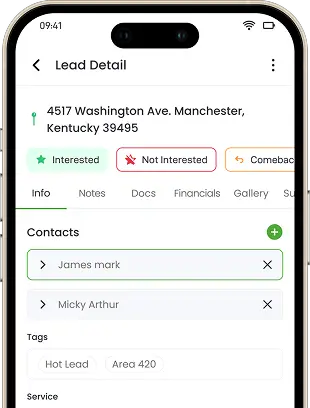
With Knockio, every rep visit, status change, and job update is tied to a live map and an activity history tied to that job. Managers can open map view to see exactly where reps are working, check job statuses to confirm what stage each conversation is at, and review notes and activity logs without chasing anyone down for an update. Instead of hoping John had a good day, a manager can see that John visited 12 homes and moved four of them into an appointment status, all before lunch.
Better Customer Experience Starts With Reliability
Customers do not remember your pitch nearly as much as they remember whether you showed up when you said you would. In field sales, satisfaction usually comes down to two things: being on time and communicating when plans change. Real time tracking helps with both.
If a rep is running behind for a solar consultation or a roofing inspection, a manager sees it immediately on the live map and can act on it. That might mean calling the customer with an updated arrival window, or sending a nearby rep to cover the visit instead. The customer never has to wonder if they got forgotten, because someone in the office already knows what is happening and can reach out first.
Without tracking, that same delay usually turns into a customer sitting at home, annoyed, wondering if anyone is coming. A fiber rep stuck in traffic before a 3 PM appointment is a normal, forgivable delay if the office catches it and calls ahead. It becomes a lost customer if nobody notices until the appointment window has already passed.
This kind of responsiveness pays off. Industry research on field service operations has repeatedly linked real time visibility to higher customer satisfaction scores, largely because customers value being told the truth about timing rather than being left to guess. A window cleaning company that can tell a new client, “our rep is five miles out and should be there in about ten minutes,” is building trust before the rep even knocks.
Tracking also protects jobs after the initial conversation. If a rep closes a roofing job or lands a hot solar lead in the field, that information should not sit in a notebook until end of day. It needs to reach the office fast enough for someone to schedule next steps while the customer is still excited.
This is where Knockio’s job structure earns its keep. The moment a rep captures a job in the field, it carries the customer’s information, address, notes, and any photos straight into a shared system. Office staff can see it land, assign it, and move it into scheduling without waiting for a rep to get back to the truck and explain what happened. A job created at 10:15 AM can have a follow up appointment booked by 10:20, which is a very different customer experience than a callback three days later.
Smarter Routes Mean More Selling Time
Route planning sounds like a small detail, but it eats or saves hours every single week. Poor planning means more driving, more fuel, and fewer doors knocked. Good route planning means the opposite.
Take a window cleaning rep with 15 stops across different neighborhoods this week. Without a plan, that rep zigzags across town, spending more time behind the wheel than in front of customers. A solid sales tracking system lets that rep, or their manager, drop in the addresses and get back a route that starts farthest out in the morning, before traffic builds, and works its way back toward the office. Same 15 stops. Far less driving.
Pair that with live tracking and you get something even more useful: the ability to adjust mid day. If traffic backs up in one part of town, a manager can redirect a rep before it costs the whole afternoon. If a solar canvasser finishes their street early, they can be pointed toward a nearby street that has not been touched yet, instead of circling back to the office with time to spare.
For teams running multiple reps across the same territory, this also solves the overlap problem. A live coverage map shows exactly which blocks have been worked and which have not, so two reps are not accidentally knocking the same door while another street goes untouched. By the end of the day, you want the map fully covered with no gaps and no duplicates, and that only happens when coverage is visible in real time.
The payoff shows up on the bottom line too. Less driving means lower fuel costs and less wear on vehicles. More stops per day mean more conversations, which usually means more jobs. And reps who are not stuck fighting traffic all day tend to bring more energy to each pitch.
Knockio supports this with territory assignment and map based coverage tracking, so managers can see which areas are worked, which are open, and how reps are distributed across a region. If one rep finishes early while another is behind, the manager can shift remaining addresses between them right from the map, without a single phone call.
Time Savings That Actually Add Up
There is a reason “time is money” gets said so often in sales. Every minute spent hunting for an address, sitting in traffic, or filling out paperwork is a minute not spent talking to a homeowner. Field research consistently shows that reps spend well under half their working hours on actual selling, with the rest lost to driving, admin work, and coordination. Real time tracking chips away at that lost time from several directions at once.
Less back and forth. Without a live dashboard, managers and reps burn time playing phone tag. “Where are you now?” “How did that last stop go?” “Can you fit in one more?” With live visibility, a manager can glance at the map, see who is closest to a hot new job, and send them there in seconds instead of making three phone calls first.
Faster adjustments. Field days rarely go according to plan. Appointments run long, some cancel, new opportunities pop up out of nowhere. If a rep suddenly has a gap at 2 PM, a manager can see that instantly and reroute them to help cover a busy street nearby, instead of that hour just disappearing.
Automatic record keeping. A good tracking system logs visit times, locations, and outcomes as they happen, so reps are not stuck reconstructing their day from memory at 6 PM. That is time back for one more visit, or just an earlier end to the day.
Fewer redundant mistakes. Nobody accidentally sends two reps to the same address, and nobody forgets to log a completed appointment. If a visit gets missed, the gap shows up immediately instead of surfacing days later when an upset customer calls to ask what happened.
With Knockio’s Automation Flow Builder, a lot of this coordination runs itself. Appointment reminders, task assignments, and status based follow up messages can fire automatically once a job reaches a certain stage, so office staff are not manually chasing every update. A job that moves into an “Appointment Scheduled” status can automatically trigger a reminder text to the customer and a task for the assigned rep, with no one having to remember to send it.
Let Your Field Data Make the Call
Running field sales well is not only about today’s numbers. It is about getting sharper over time, and that requires data, not instinct. Real time tracking generates a running record of where reps go, how long they stay, and what results follow. Reviewed regularly, that record turns hunches into decisions you can actually defend.
A few examples of what tends to surface:
- Which areas convert. A fiber team might notice one neighborhood consistently outperforms another. That is a signal to put more reps there, and maybe pull back from areas that rarely convert.
- When deals actually close. A solar team might find early evening visits close far more often than mid afternoon ones, once homeowners are back from work. A window cleaning company might see Saturdays outperform Wednesdays. Either finding is reason enough to shift the schedule.
- What top performers do differently. If one roofing rep closes half their conversations while another closes a fifth, the gap is worth digging into. Maybe the top performer spends more time per visit, or always follows up within a day. That is a coaching opportunity, not a mystery.
- How fast jobs move. If a job sits untouched for a week before anyone follows up, that is a process problem, not a rep problem, and it is one worth fixing before it costs more sales.
None of this replaces good judgment. It just gives that judgment something solid to stand on. Instead of guessing what training the team needs, the data points to it directly. Instead of assuming coverage is even across territories, the data shows the gaps plainly.
Inside Knockio, every job carries its full activity history, from the first canvass note to the final invoice. Boards and list views let managers filter by status, territory, or rep, so patterns are visible without exporting anything to a spreadsheet first. A manager reviewing the week can see which statuses jobs are stalling in, which reps are moving jobs through the fastest, and where the pipeline needs attention, all from the same system reps are already using in the field.
From Sales Rep to Signed Job: Where Knockio Fits
Most tracking tools stop at the map. They show you where reps went and leave the rest to guesswork. That gap is exactly why teams end up stitching together five or six separate tools: one for canvassing, one for scheduling, one for estimates, one for invoicing, and one more just to keep everyone updated.
Knockio was built to close that gap. A job created in the field carries the homeowner’s information, notes, and any photos straight through to an appointment, a work order, an estimate, and an invoice, all inside the same record. A rep who tracks a job in map view during canvassing hands it off to the office, who can move it into an appointment, assign a crew, generate a work order, and collect payment through text to pay, tap to pay, card, or ACH, without anyone re-entering the same customer details three separate times.
That is the real value of tracking. It is not just knowing where your team has been. It is connecting that visibility to everything that happens after the knock, so a solar company, a roofing crew, a window cleaning team, or a fiber provider is running one connected system instead of patching together five or ten disconnected tools.
The Bottom Line
Real time sales team tracking is not a novelty map with moving dots. It is a working tool that builds accountability, keeps customers informed, tightens up routes, saves real hours, and gives managers something solid to base decisions on. For solar, roofing, window cleaning, and fiber sales teams working in competitive markets, that combination is becoming close to a baseline expectation rather than an extra.
Put it to work and the payoff shows up quickly. No more finding out about a missed appointment after the customer has already called to complain. No more guessing which territory needs more reps. A manager can catch a problem at 2 PM instead of hearing about it at close of day, and can send help to a struggling rep before the day is a total loss.
There is also a trust dimension worth noting. Teams that see decisions grounded in real data, rather than arbitrary rules, tend to buy into the system faster. The message that matters is simple: this is not about watching every move. It is about giving the team backup when they need it and recognition when they earn it.
Customers notice the difference too. People are used to tracking a pizza delivery or a rideshare down to the minute, so a home service company that can say “your technician is ten minutes out” reads as competent, not flashy. That kind of reliability builds the word of mouth that keeps a pipeline full without extra ad spend.
If your team is still running on guesswork and end of day recaps, door to door and on site sales has moved past the point where that is good enough. Real time visibility, paired with a system that carries every job from first knock to final payment, is what separates a team that reacts to problems from one that gets ahead of them.

Waqar Hussain leads SEO and digital media at Knockio, a field sales and field service management (FSM) platform for businesses managing sales reps, field teams, jobs, and customer appointments. He focuses on content strategy, search growth, and digital media to help more teams discover better ways to manage leads, jobs, and field operations.