Summary:
Roofing sales rep tracking software gives contractors a live view of where reps are, which streets got covered, and which appointments are at risk. It cuts missed appointments, keeps territory coverage honest, and turns end of day guesswork into real numbers managers can coach with. When tracking connects to the rest of the job record, a door knock can flow straight into an appointment, an estimate, a work order, and a payment without anything getting retyped or lost.
Summarize with:
Roofing is a business of timing, trust, and teamwork. If you run an in-house sales team or a crew of canvassers, you already know the math. A rep in the right neighborhood at the right moment books an inspection. A rep at the wrong address burns half a day and gives a competitor the opening. The same pressure sits on your install crews. Storm season does not wait for anyone.
Now picture a live map of your whole field operation. Every rep. Every canvasser. Every appointment. You can see who is where, what they are working on, and how the day is going while there is still time to fix it. That is what a roofing sales tracking app gives you. For contractors managing canvassers or a full field sales crew, it changes how the day gets run.
A modern roofing sales rep tracking software shows you exactly where your team is and what they are doing in real time. And the same visibility works for crews out on production jobs, not just salespeople knocking doors.
This guide walks through how tracking actually helps a roofing company. We will cover how live GPS tracking builds accountability, how it cuts down on missed appointments, how to measure rep performance with real numbers, and how tracking data should connect to your roofing CRM so a door knock can turn into a job without anyone retyping anything. We will also cover the features that matter most for roofing companies specifically.
One thing up front. Tracking is not about spying on your people. It is about field control. It protects the day, protects your reps, and makes sure no homeowner who raised their hand gets forgotten. Here is how sales tracking can transform the way you manage your roofing sales force.
Benefits of Roofing Sales Rep Tracking Software
Why Tracking Your Field Sales Team Matters
Running a roofing sales team without tracking is a guessing game. You send reps out in the morning, then wait for evening reports and hope the numbers are good. That gap between morning and evening is where money leaks out.
Here is what usually goes wrong without visibility:
- Missed appointments. A rep gets tied up in a long conversation or simply forgets. A homeowner waits by the door, then calls another roofer. Every missed meeting costs you a sale and a piece of your reputation.
- Uneven territory coverage. Some reps skip the streets that are harder to park on or farther from lunch. Others accidentally knock on the door a teammate hit last week. Homeowners notice both.
- Weak accountability. The day ends with a few new appointments, and nobody can say why. Was the neighborhood cold, or did the afternoon disappear? Without data, you are guessing.
- Slow follow ups. A rep meets an interested homeowner, but the office does not hear about it until tomorrow, or ever. The inspection never gets scheduled. The quote never goes out.
None of this means your team is lazy. Most of the time it is a visibility problem, not a people problem. Even your most honest, hardest-working rep benefits from a system that keeps everyone looking at the same picture. If a canvasser has not checked in at any new addresses by noon, you can call and ask what is going on. Maybe they hit a dead zone. Maybe they need backup. You can also use that touchpoint to coach, walking them through the different types of roofing, shingles, and materials so they sound like an expert at the door instead of a script reader.
Tracking turns guesswork into clarity. You can reassign the closest rep to a hot prospect two streets over because you actually know who is closest. You can catch a missed appointment while the homeowner is still willing to wait fifteen minutes, instead of finding out three days later when they call upset. That is the real value. Not surveillance. Decisions made while they still matter.
Real Time GPS Sales Tracking Keeps Everyone Accountable
The core advantage of modern tracking is seeing where your team is right now, on a map, as they move from house to house or appointment to appointment.
Say a rep is scheduled to canvass a specific neighborhood all morning. A glance at your phone confirms they are actually there, working the right streets. If they detour or park at a coffee shop for ninety minutes, you see that too. This is not about catching people. It is about trust with verification. When reps know the system exists, most of them simply stay focused. The visibility alone does the work.
Live tracking also saves appointments before they die. A new customer meeting is set for 3:00 PM across town. At 2:45, you check the map and see the assigned rep is still twenty minutes out, or worse, heading the wrong direction. Now you have options. Call the rep. Call the homeowner with an honest update. Send a nearby teammate instead. The homeowner is never left standing at the window wondering if your company is serious. Over a season, those small interventions add up to a very different reputation.
There is a defensive benefit too. Good tracking apps keep a history of every route and stop. If a homeowner says nobody from your company ever came by their street, you can pull the log and check. That protects your reps by proving their work. It also exposes gaps. If the history shows a block was only half covered, you send someone back to finish it. No potential customer gets skipped because a rep ran out of daylight and nobody knew.
This is where field control matters more as teams grow. With five reps, you might hold the picture in your head. With fifteen, you cannot. Managers need to see if one rep is stuck in a weak pocket while another covers too much ground with too few conversations. Maybe a team lead should drive over and shadow a struggling rep for an hour. Used the right way, live rep tracking protects the day and lets managers coach while the work is still happening, not at Friday’s meeting when the week is already gone.
With Knockio, managers get map-based team visibility alongside job views, rep activity, assigned areas, statuses, and field updates. You can see where work is moving, where follow up is stalling, and which jobs need attention before the day gets away from you. And because reps drop pins and log outcomes as they knock, the map is not just dots. It is a record of every conversation, every no-show, and every homeowner who said come back next week.
Reducing No Shows and Missed Appointments With Tracking Tech
Missed appointments are not just a doctor’s office problem. They happen in roofing sales all the time, and each one can cost you a job worth ten or twenty thousand dollars. Tracking tech attacks the problem from three angles.
First, scheduling and reminders live in the same system as the map. Managers assign appointments through the platform, so each rep opens their phone in the morning and sees exactly what is on their plate. As an appointment gets close, the app reminds them. Combine that with the live GPS view, and you catch problems early. Rep stuck in traffic? You see it on the map before the homeowner feels it. A quick call that says our representative is on the way but running fifteen minutes late does more for trust than most marketing spend. It tells the customer someone is actually managing the process.
Second, visibility creates responsibility. When reps know their schedule and location are visible to the team, casually blowing off a 4:30 appointment stops being an option. It works the way a visible progress bar works. People manage their time better when the time is on display. Over a few months, missed appointments go from a weekly headache to a rare exception.
Third, the history tells you where your scheduling process is broken. Suppose Monday mornings keep producing rescheduled meetings, or one rep shows a pattern of late arrivals on the far side of your service area. The logs surface. Maybe Mondays need a team huddle before anyone leaves. Maybe that rep’s territory is simply too spread out and needs to be redrawn.
In Knockio, appointments live on the job itself, next to the homeowner’s contact info, address, notes, and any photos from the first visit. When a rep books an inspection at the door, the office sees it immediately. And with Knockio’s Automation Flow Builder, you can set up automatic text or email reminders to homeowners before appointments, plus follow up messages when a visit gets marked complete or missed. Nobody has to remember to send the reminder. The system sends it, and the job’s activity history shows it went out.
Tracking Performance and Productivity
Tracking is not only for catching problems. It is how you find and multiply good work.
Once your field team logs activity through a tracking system, you gain real numbers on the day. How many doors does each canvasser hit per hour? How many conversations turn into booked inspections? Which reps close the most, and what do their days actually look like compared to everyone else’s?
Say one rep consistently visits 40 homes a day while another manages 25 over the same hours. Now you can investigate instead of guessing. Maybe the first rep plans tighter routes. Maybe the second spends longer at each door, which could be great if those conversations convert, or a sign of hesitation that a little coaching would fix. Either way, you have moved from hunches to measurable data. You are no longer relying on end-of-day summaries like it was a slow one out there. You can see exactly what slow means in numbers.
Real numbers also make goals fair. When you know what top performers actually achieve, you can set targets the whole team believes in. So many new appointments per week. So many quality conversations per day. When targets get missed, the data shows you why. Bad weather. A territory full of new construction that does not need roofs yet. A rep who logs almost nothing after 4 PM and might need an end-of-day check-in or a better incentive.
The training signals are often the most valuable part. A rep with lots of door conversations but few booked appointments probably needs help with the pitch or the close, not more doors. A rep with great appointment numbers but weak signed contracts might need support on the estimate presentation. You cannot see any of that from a spreadsheet someone fills in from memory on Friday.
In Knockio, every knock, disposition, note, and status change gets stamped to the record with a time and a name. Managers can review rep activity by day, by area, or by outcome, and use custom job statuses to define exactly what their pipeline stages mean. A team that tracks knocked, interested, inspection booked, and estimate sent as distinct statuses can see precisely where each rep’s funnel leaks. That is coaching material you can act on Tuesday, not a vague feeling you bring up at the monthly meeting.
Integrating Tracking With Your Roofing CRM
Here is where most tracking setups fall apart. The map lives in one app. The customer records live in another. The estimates live in a third. Every handoff between them depends on somebody retyping information, and every retype is a chance for a job to vanish.
Think about the old way. A canvasser knocks a door, has a great chat with a homeowner, and scribbles a name and number in a notebook. That evening, if the notebook survived the rain and the truck seat, someone enters it into a spreadsheet at the office. The follow up call happens a day or two later, if the note is still legible. Compare that to an integrated sales rep tracking software where the rep enters the homeowner on the spot and it syncs to the office instantly.
Here is what that looks like in practice. Your rep John, meets Mrs. Smith, who wants a roof inspection. Standing on her porch, John creates the record in the app with her name, address, phone number, and what she needs, then books the inspection for tomorrow afternoon. The moment he saves it, the office sees it. By the time John reaches the next street, Mrs. Smith already has a confirmation text. No duplicate entry. No lag. Nothing is slipping through the cracks.
Integration also ties location data to the customer record. The system logs that John visited 123 Elm Street at 2:30 PM. Months later, when Mrs. Smith’s project is complete, you have the full story of that relationship from first knock to final payment. If anyone ever asks whether your company came by, the answer is one search away.
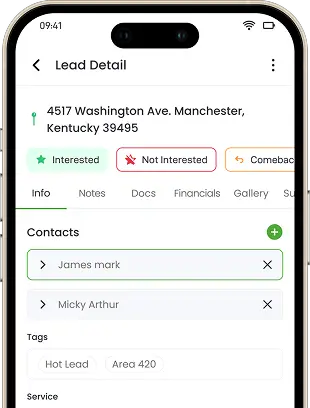
This is exactly how Knockio treats a job. In Knockio, a job is not a name and a phone number. It is the complete record: customer information, address, contacts, assignees, custom fields, notes, appointments, uploaded photos and files, surveys, and even pre-knock homeowner data from before the first conversation. When John photographs hail damage on Mrs. Smith’s shingles, those photos attach to her job right there in the field. When the estimator arrives tomorrow, everything is already waiting.
Then the job keeps moving. The estimate gets built in the same system, with optional line items, a product and service catalog, and a digital signature for Mrs. Smith to accept on the spot. Once she signs, the job status changes, it shows up on the production board, and a work order goes to the install crew with tasks, materials, schedules, and crew notes attached. Material takeoffs can link to inventory, purchase orders go to suppliers, and vendor bills land on the same job. When the roof is done, the invoice goes out from the same record, and Mrs. Smith can pay by text to pay, credit card, or ACH, or the office can enter a check manually. Every step, from John’s first knock to the final payment, lives in one activity history.
That is the difference between tracking software and a connected system. The tracking gets the lead in the door. The system carries the job all the way through, and it can replace the five to ten separate tools most roofing companies duct tape together to do the same thing.
Choosing and Implementing the Right Tool
With the benefits clear, the last step is picking a tool that fits your roofing business. Weigh your team size, your budget, and the specific gaps you have identified. Some contractors patch together general purpose tracking apps and a standalone CRM. Others choose software built for field sales and home service work from the start.
Knockio takes the second approach. It combines live GPS rep tracking, territory and route planning, and a home service focused CRM in one platform, along with the estimates, work orders, invoicing, and payments that carry a sold job through production. That matters because every separate tool you remove is one less monthly bill, one less login, and one less place for job information to go missing. Whatever you choose, make sure it is genuinely easy for reps to use on a phone while standing on a porch. A powerful system nobody opens is worth nothing.
Once you pick a tool, the rollout decides whether it sticks. Train the team properly and lead with what is in it for them. The app logs their leads automatically. It reminds them about appointments. It proves their work when a commission question comes up. Consider a short pilot with one or two reps for a week, collect their feedback, and let their results sell the rest of the team. Reps trust a teammate’s experience more than a manager’s memo.
Set clear policies on how tracking data gets used, and say them out loud. You will use it to rebalance workload when someone is swamped, to spot where training helps, and to back reps up in disputes. Not to play gotcha. When the team understands the purpose, adoption stops being a fight.
In Knockio, you can go one step further by shaping the system around your process rather than the other way around. Job statuses are fully custom and unlimited, so a canvassing team can run statuses like new knock, interested, inspection booked, and estimate sent, while production runs its own set. Each board shows only the jobs whose statuses belong to it, so sales sees a sales pipeline, and production sees a build schedule, without either team wading through the other’s work. List view, map view, and board view let each person see the same jobs the way their role needs to.
Key Features to Look For
When comparing roofing sales rep tracking apps, look for more than a map. The tool should include:
- Real time GPS tracking so you know where reps are throughout the day.
- Check in and activity logs so you can see visit duration and outcomes, not just locations.
- Pin drops for prospects so reps can mark interested homeowners instantly at the door.
- Route history so you can review coverage, spot skipped streets, and verify work.
- Mobile apps that reps actually like because the best system is the one your team opens without being told.
- A connected job record so the knock, the appointment, the estimate, the work order, and the payment all live in one place instead of syncing between separate tools.
That last point is the one that separates a tracking app from a business system. If tracking data stops at the map, you still need three or four other tools to run the job. If it flows into estimates, job scheduling, work orders, and invoicing, you are running your whole operation from one place. That is also the honest comparison to make when you look at tools like Jobber, ServiceTitan, Workiz, or Housecall Pro. Ask each vendor to show you the full path from a door knock to a collected payment, and count how many extra tools you would still need to buy.
Conclusion
Roofing has always been a business on the move. Trucks in neighborhoods, reps at doors, crews on ladders. Real-time tracking brings control to that moving world. Instead of wondering what happened in the field today, you know. And knowing lets you act: shift a rep toward a hot street, help someone who is struggling, and make sure every interested homeowner hears back before they call the next company.
Tracking your team with roofing sales rep tracking software is not about breathing down anyone’s neck. It builds a culture where good work is visible and gets recognized. Your salespeople stay the heart of the business, the trusted faces at the door. The system behind them makes sure their follow-ups never slip, and their effort never goes uncounted.
For you as the owner, it shows up as fewer fires. Fewer missed appointments and a stronger reputation. Real performance numbers instead of end-of-day stories. And when the tracking connects to the rest of the job, from estimate to work order to invoice to payment, your whole operation runs on one set of facts, from the curb to the office.
No roof replacement should slip away because of a lost sticky note or a forgotten appointment. With live tracking and a connected job record, every day in the field is accounted for, every rep is supported, and every homeowner gets the follow-up they were promised. If you want to see how that looks with your team, your territories, and your workflow, book a free demo and walk through it with someone who knows how roofing jobs actually move from first knock to final payment.

Waqar Hussain leads SEO and digital media at Knockio, a field sales and field service management (FSM) platform for businesses managing sales reps, field teams, jobs, and customer appointments. He focuses on content strategy, search growth, and digital media to help more teams discover better ways to manage leads, jobs, and field operations.