Home Service Business Software in 2026: What the Data Shows
Disclosure: Knockio builds software in this category. Every statistic below comes from a third-party source and is linked at the bottom.
If you’re shopping for home service business software right now, most of the pitches you’re hearing are about features. The more useful question is narrower: where is your company already losing money, and can software stop it?
Start with the market you’re operating in. American homeowners spent an estimated $521 billion on improvements and maintenance to owner-occupied homes over the four quarters ending in Q1 2026. The Harvard Joint Center for Housing Studies expects that to reach $523 billion by early 2027 (Harvard JCHS, Leading Indicator of Remodeling Activity, May 2026).
Half a percent. A very large market that has stopped growing.
Back in 2023, when the same index was posting double-digit annual gains, sloppy operations were survivable. Leads slipped. Estimates went out three days late. Nobody noticed, because there was another lead behind it.
At half a percent, there is no lead behind it.
We went through the federal data, the trade surveys, and two Harvard Business Review studies to figure out where the money actually goes. What follows is what we found, and what it means for the software you buy.
What’s in here:
- The market you’re buying software for
- Why demand is locked in for the next decade
- Why most home service software is built for the wrong company
- The labor math, by trade
- Four places home service companies lose money
- What this software actually includes, and what it costs
- Five questions to ask before you buy
Short on time? See how Knockio handles it, or book a 15-minute demo.
The Market You’re Buying Software For
What the federal data says
The US Census Bureau put total construction spending at a seasonally adjusted annual rate of $2.21 trillion in May 2026, with private residential construction accounting for $930.2 billion of that (US Census Bureau, Monthly Construction Spending, released July 1, 2026).
Specialty trade contractors, the census category covering most home service work, employed 5.25 million people as of March 2026. There were 599,074 private establishments in the category as of Q4 2025 (Bureau of Labor Statistics, Industries at a Glance: NAICS 238).
Private research lands in the same place. IBISWorld sizes US handyman services alone at $365.4 billion across roughly 529,000 businesses in 2026, after five years of 2.6% compound annual growth, with a 0.8% contraction expected this year.
What homeowners are actually spending
Consumers haven’t stopped spending. They’ve stopped spending impulsively.
Angi’s State of Home Spending report found the average homeowner spent $12,472 on their home in 2025, up 3.5% from $12,050 the year before, across an average of 10 projects rather than 9 (Angi, January 2026).
So: more jobs, thinner tickets. Volume’s holding. Ticket sizes aren’t. Whatever margin you get this year, you’re going to have to run it out of your own operation.
With Knockio: When average job value flattens, throughput becomes the lever. Knockio keeps canvassing, scheduling, dispatch, and invoicing in one system so more jobs move per week without adding office headcount to manage them.
Your Demand Problem Isn’t a Demand Problem
The American Community Survey has one number worth taping to a wall.
The median age of an owner-occupied home in the United States hit 42 years in 2024. In 2005 it was 31 (National Association of Home Builders analysis of ACS data, March 2026). Nearly 47% of owner-occupied homes were built before 1980. Roughly 34% predate 1970.
Between 2014 and 2024, the share of owner-occupied homes at least 45 years old climbed from 39% to 47%, while homes built within the last 14 years fell from 18% of the stock to 13%.
Roofs fail. Water heaters fail. Panels max out, and the HVAC system installed during the Clinton administration is getting replaced right now, by somebody. Aging housing stock doesn’t check the Fed’s calendar.
There’s a second lock-in effect worth knowing about. Angi found 74% of millennial homeowners said mortgage rates were pushing them to improve their current home instead of moving. People staying put means people renovating, and it means the same homeowner needs you again in three years.
Why Most Home Service Business Software Is Built for the Wrong Company
Here’s the number the software category tends to talk around.
Analysis of Census Bureau County Business Patterns data by CPWR found that from 2014 to 2023, 91.0% of payroll establishments in construction had fewer than 20 employees. More than four out of five, 81.7%, had between one and nine (CPWR, Data Bulletin, April 2026). Nonemployer establishments — owner-operators with no payroll at all — grew 20.8% over the same period, from 2.4 million to 2.9 million.
If you’re running a crew of eight, you’re not the exception in this industry. You’re the median.
Now think about what enterprise field service software assumes. It assumes an operations manager. A dispatcher. A dedicated CSR team. An admin who reconciles the CRM against the accounting system on Fridays. A three-month onboarding window, and somebody whose actual job is owning the rollout.
Most home service companies have none of that. The owner is the operations manager. And the dispatcher. And the guy who forgot to send Tuesday’s invoice — he was on a roof in Tulsa.
When people say home service businesses “resist technology,” this is what they’re actually observing. The tools were designed for a company structure that 91% of the industry doesn’t have.
With Knockio: Built for small teams and 100+ user enterprises alike. Get started at $25/user/mo (1–4 users) or $20/user/mo (5+ users). Explore our flexible pricing plans
The Labor Math
The Bureau of Labor Statistics publishes ten-year occupational projections. Here are the 2024–2034 figures for the four core trades:
| Trade | 2024 employment | Projected growth | Openings per year | Median pay (2024) |
|---|---|---|---|---|
| Electricians | 818,700 | 9% | ~81,000 | $62,350 |
| Plumbers, pipefitters, steamfitters | 504,500 | 4% | ~44,000 | $62,970 |
| HVAC and refrigeration techs | 425,200 | 8% | ~40,100 | $59,810 |
| Roofers | 166,700 | 6% | ~12,700 | $50,970 |
Source: US Bureau of Labor Statistics, Occupational Outlook Handbook, 2024–2034 projections.
That’s roughly 178,000 openings a year across four trades, and you’re competing for those hires against every other shop in your county. Most of those openings are replacements for people retiring or leaving the field, not net new positions.
Meanwhile there were 259,000 open construction jobs in April 2026 (BLS Job Openings and Labor Turnover Survey, via FRED).
So what does that leave you with? The Federal Reserve’s 2026 Report on Employer Firms, based on 6,525 employer firms surveyed between September and November 2025, ranked hiring or retaining qualified staff as the second most common operational challenge small businesses face. The first was reaching customers and growing sales.
You can’t hire your way out of a bottleneck, and you’re simultaneously struggling to find enough work for the technicians you already have. Same root cause. The work isn’t moving cleanly through the business.
Where Home Service Companies Actually Lose Money
Four leaks. Each one is measurable, and each one has research behind it.
Leak 1: Leads go cold before anyone touches them
The most-cited work on this is still a 2011 Harvard Business Review audit, and nobody has replicated it at that scale since. James Oldroyd, Kristina McElheran and David Elkington examined response behavior at 2,241 US companies and tracked 1.25 million sales leads across 42 firms.
Their findings: 37% of companies responded to a lead within an hour. 16% responded within one to 24 hours. 24% took longer than a day. And 23% never responded at all. Among companies that responded within 30 days, the average response time was 42 hours.
The conversion penalty is brutal. Firms that contacted a prospect within an hour were nearly seven times as likely to qualify that lead as firms that waited just one hour longer, and more than 60 times as likely as firms that waited a full day (Harvard Business Review, The Short Life of Online Sales Leads, March 2011).
Now apply that to field sales. A canvasser knocks a door at 4:15 pm. The homeowner is interested. The rep writes it on a notepad or drops it in a personal notes app, finishes the street, drives home, and enters it into the CRM the next morning if he remembers.
That lead is already outside the seven-times window. It was outside it before the rep got back to the truck.
With Knockio: A lead captured at the door lands in the pipeline instantly, with the address, the notes, a voice memo if the rep prefers talking to typing, and a follow-up assigned. Nothing waits for the end of the shift.
Leak 2: Your software stack has become a second job
ServiceTitan surveyed more than 1,000 US residential service contractors and asked what technology they use. The answers overlapped heavily: 63% use business management software, 48% use field service management software, 42% use accounting software, and 38% use an ERP system (ServiceTitan, Residential Services Industry Research).
That’s not four categories of company. That’s one company running four systems.
The cost of that is documented. A Harvard Business Review study by Rohan Narayana Murty, Sandeep Dadlani and Rajath B. Das tracked 137 users across 20 teams at three Fortune 500 companies for up to five weeks. Workers toggled between applications roughly 1,200 times per day, and spent just under four hours a week reorienting themselves afterward. Nine percent of the week, gone to re-finding your place (Harvard Business Review, August 2022).
Do the math on your own week. Nine percent of 50 hours is four and a half. For an owner-operator, that’s most of a Friday, every week, spent moving between a canvassing app, a CRM, a scheduling tool, an invoicing platform, and the spreadsheet that reconciles the ones that don’t talk to each other.
Salesforce’s State of Sales report, based on 4,050 sales professionals across 22 countries surveyed in August and September 2025, found reps now spend only 40% of their time actually selling. Among sales leaders already using AI, 51% said disconnected systems were slowing their AI initiatives down.
We put real numbers on this specific problem in The cost of running separate canvassing and field service software.
Curious what your own stack is costing? See what one platform runs — $20 per user per month, no setup fee.
Leak 3: The sales-to-operations handoff
This is the leak owners underestimate most. It never shows up as a lost deal. It shows up as an extra hour on a Thursday, and then it shows up again.
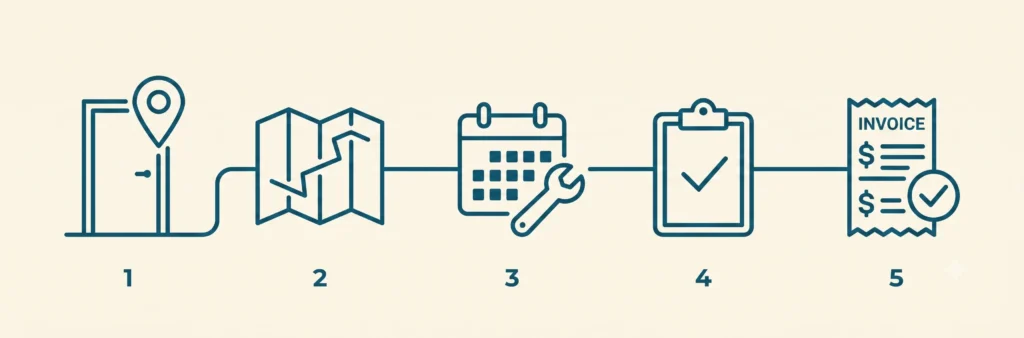
A rep closes at the door. Somebody re-keys the customer into the CRM. Somebody else builds the estimate in a separate tool. The signed contract arrives as a PDF in an email thread. Dispatch schedules the crew from a whiteboard or a shared calendar. The crew shows up without the photos the rep took of the damaged section. The invoice gets rebuilt from scratch in accounting software, from a job number nobody wrote down correctly.
Every one of those transitions is a place the job can change shape. Wrong address, missing scope, a discount the rep promised that never made it onto the invoice. Or a callback because nobody told the crew about the dog.
The Federal Reserve survey named reaching customers and growing sales as the top operational challenge for small employer firms. But you can’t grow sales through a pipeline that leaks at every handoff.
With Knockio: The record created at the door is the same record the crew works from and the same record the invoice is generated against. Photos, notes, contracts and scope travel with it through work order management. Nobody retypes anything.
Leak 4: Cash arrives last, slowly
Home service is one of the few industries where the work’s done, the customer’s happy, and two weeks later you still haven’t been paid.
The Federal Reserve’s 2026 survey found rising costs of goods, services and wages to be the top financial challenge for small employer firms, with more than four in ten also citing tariff-related increases. Seventy-seven percent reported one of those two pressures or both. Revenue expectations fell to their lowest index level since the 2020 survey.
When margins compress, days-to-payment stops being a bookkeeping detail and becomes a survival metric. If you’re waiting 21 days to invoice because the paperwork sits in three systems, you’re financing your customers for free at the exact moment you can’t afford to.
With Knockio: Estimates convert to contracts, contracts to work orders, work orders to invoices, and invoices to collected payment inside one flow. The crew can close out and collect on site.
What Home Service Business Software Actually Includes
The category is broader than most buyers realize, and vendors rarely cover all of it. Five functional blocks:
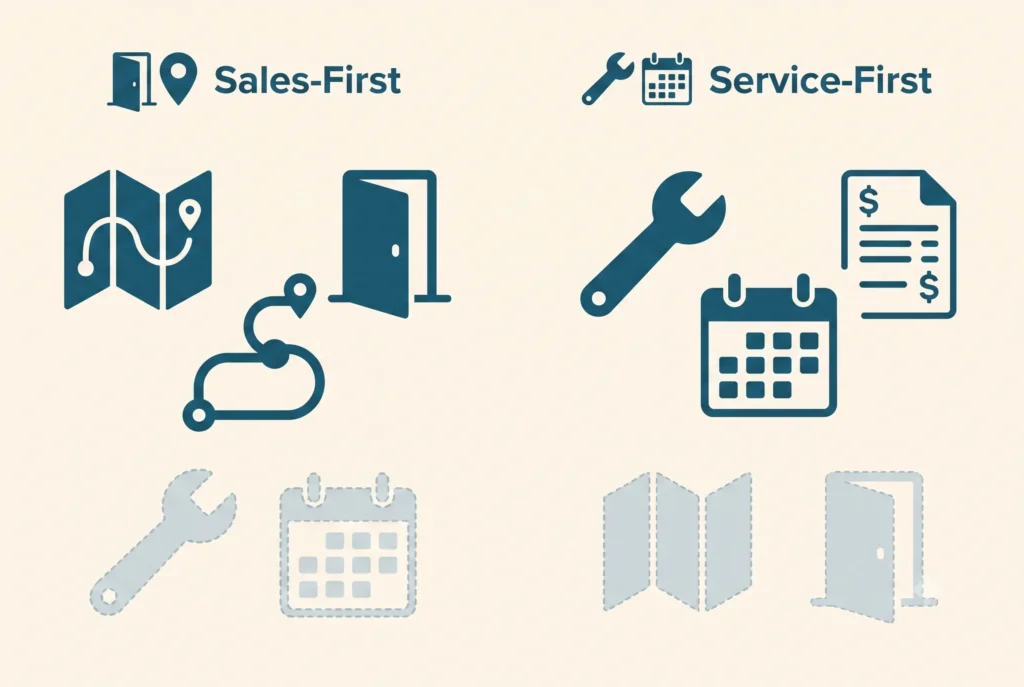
Lead generation and field sales. Door-to-door canvassing, territory management, route planning, GPS tracking, and rep performance reporting. Mostly ignored by traditional field service management platforms, which assume the lead arrives by phone.
CRM and pipeline. Customer records, deal stages, follow-up sequences, and business texting and calling.
Job execution. Scheduling, crew dispatch, work orders, photo and document capture, and inventory.
Money. Estimates, digital contracts with e-signature, invoicing, and payment processing. This is where accounting integrations matter — most shops still run QuickBooks behind whatever else they use, so check the integration list before you commit.
Reporting and automation. Dashboards and automated reminders, follow-ups and status updates.
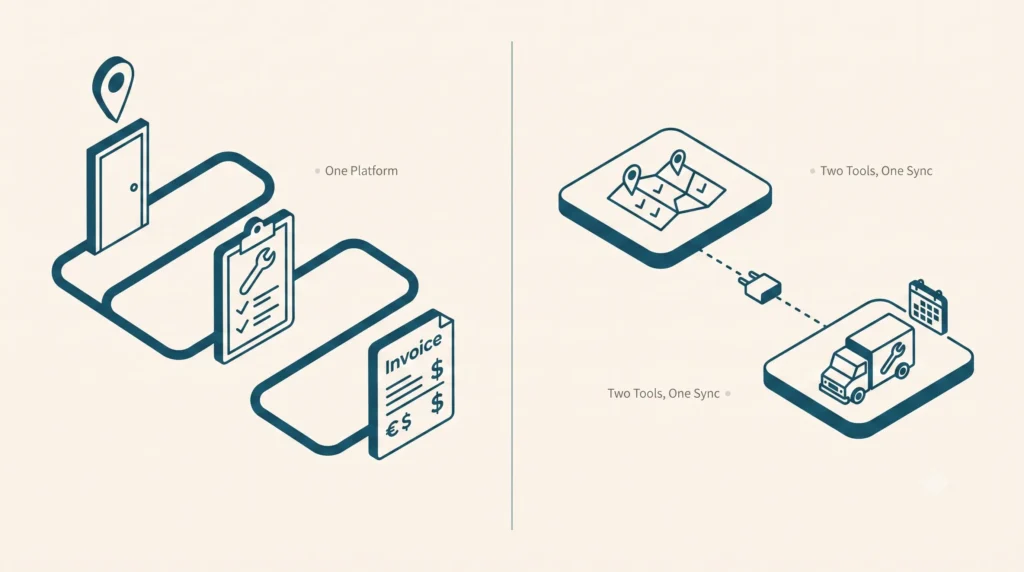
Most companies buy blocks one and two from one vendor and blocks three through five from another. That’s the split that creates Leak 3.
What Home Service Business Software Costs in 2026
Rough market bands, per user per month, for a small to mid-sized shop:
$20–$40. Single-purpose tools. A canvassing app, or a scheduling and invoicing tool. Cheap, fast to adopt, and you’ll need two or three of them.
$40–$100. All-in-one platforms aimed at small business. Usually cover CRM through invoicing. Field sales coverage varies widely and is worth testing specifically.
Quote-only. Enterprise field service management. Often five figures a year plus implementation, with onboarding measured in months. Built for the 9% of contractors with 20 or more employees.
Two costs almost nobody quotes: setup fees, which can run into the thousands, and the parallel-running period where your team maintains the old system and the new one at once. For a ten-person company, a platform that takes a quarter to implement may never pay itself back.
What All-in-One Home Service Software Fixes, and What It Doesn’t
Consolidation gets oversold, so let me be precise.
It won’t sell for you. A bad pitch on a doorstep is a bad pitch no matter what app records it. And it won’t install follow-up discipline in a company that has none.
What it removes is the money that falls between systems. Based on the research above, that includes the seven-times conversion penalty on slow lead response, the 9% of work time lost to application toggling, the 60% of selling time that goes to non-selling activity, and the working capital tied up in a slow invoice cycle.
None of those are strategy problems. They’re plumbing problems. And unlike interest rates, they’re inside your control.
Where Knockio Fits
Knockio is a unified field service platform built for the small and mid-sized home service company. It covers the two halves that usually get bought separately.
The canvassing side
Door-to-door lead capture, territory mapping, route optimization, GPS tracking, notes and voice memos, and pipeline management.
The operations side
Scheduling, crew dispatch, work orders, estimates, digital contracts with e-signature, invoicing, payment collection, inventory, and reporting.
Both run on native iOS and Android apps. The people using them are standing in a driveway.
Coverage and pricing
Knockio runs across 15 verticals. The big ones: roofing, solar, HVAC, plumbing, electrical, fiber internet, pest control, landscaping, pool service and restoration.
Plans start at $20 per user per month at five seats, $25 below that, with no setup fee and no contract. You can run the canvassing module alone, the CRM alone, or both connected.
5 Questions to Ask Before You Buy Home Service Business Software
In order of how much money they represent.
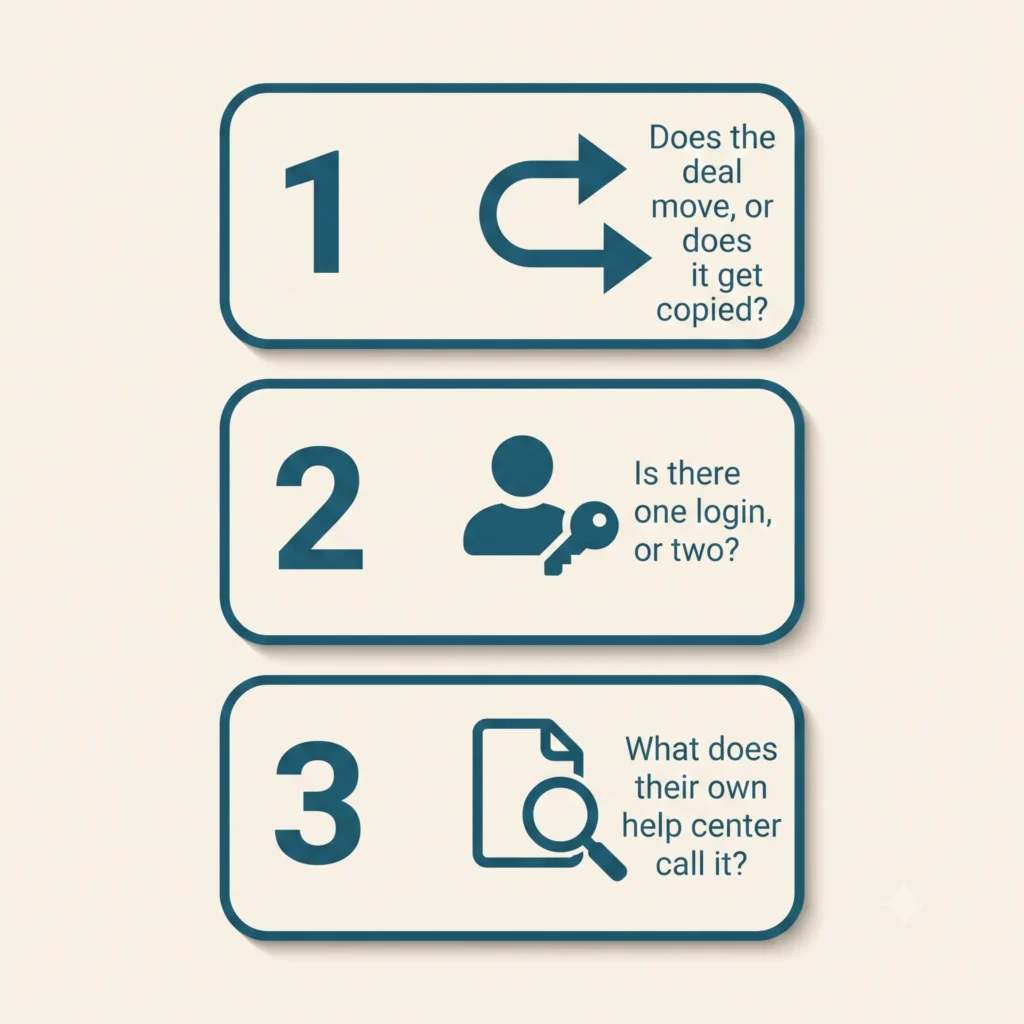
1. How long does a lead sit between capture and first contact?
Time it for one week. If the answer is measured in hours rather than minutes, that’s your most expensive problem, and the HBR data tells you roughly what it costs.
2. How many systems does one job touch from door to deposit?
Count them honestly, including spreadsheets and group chats. Every number above one is a place data gets retyped.
3. How many times does the same information get entered?
Customer name, address, scope, price. If any of those get typed twice, you’re paying for the same work twice and inviting a mismatch.
4. Can a rep in the field do the whole job on a phone?
If any step requires getting back to an office computer, that step will happen late or not at all. Test it on a real job, not a demo account. Our take on what that should look like is in Field Service CRM.
5. What does onboarding actually cost?
Not the license fee. The hours your team spends learning it, migrating data, and running two systems in parallel.
If you’re comparing against a specific incumbent, we publish head-to-head breakdowns for ServiceTitan, Jobber, Housecall Pro, JobNimbus, FieldPulse and SPOTIO.
Frequently Asked Questions
What is home service business software?
Software that manages the operational workflow of a residential service company: capturing and tracking leads, scheduling jobs, dispatching crews, producing estimates and contracts, and invoicing and collecting payment. Some platforms cover only the sales side, some only the back office, and fewer cover both.
How much does home service business software cost?
Single-purpose tools run roughly $20–$40 per user per month. All-in-one platforms for small business typically land between $40 and $100. Enterprise field service management is usually quote-only and often five figures a year plus implementation. Knockio starts at $20 per user per month with no setup fee.
How big is the home services industry in 2026?
Harvard’s Joint Center for Housing Studies puts annual spending on improvements and maintenance to owner-occupied homes at $521 billion as of Q1 2026, projected to reach $523 billion by early 2027. US Census data shows private residential construction running at a $930.2 billion annual rate as of May 2026.
What’s the difference between field service management software and a CRM?
A CRM tracks the customer relationship and the sales pipeline. Field service management software runs the job: scheduling, dispatch, work orders, and job costing. Most home service companies need both, which is why they end up with two systems and a reconciliation problem.
Is all-in-one home service software better than separate tools?
For most small shops, yes, and the reason is measurable. A Harvard Business Review study found workers toggling between applications about 1,200 times a day, costing just under four hours a week, roughly 9% of work time. Separate tools also break the sales-to-operations handoff, where scope and pricing errors originate.
Does home service software work with QuickBooks?
Most established platforms offer some form of accounting sync, but depth varies a lot. Confirm whether it pushes invoices only, or invoices plus payments plus customer records, before you commit. Knockio’s current list is on the integrations page.
How fast should you respond to a home service lead?
Within an hour, and ideally within minutes. The Harvard Business Review audit of 2,241 companies found that contacting a lead within one hour made a firm nearly seven times more likely to qualify it than waiting a single hour longer, and more than 60 times more likely than waiting a full day.
Ready to Close the Gaps?
The market isn’t going to grow you out of this one. Half a percent says so. What’s left is the revenue already sitting in your pipeline that never turns into a collected invoice.
Book a 15-minute demo. Bring one job you lost last month and we’ll show you where it leaked. No setup fee, no contract.
Sources
Market size and growth
- Harvard Joint Center for Housing Studies, Leading Indicator of Remodeling Activity, May 2026: https://www.jchs.harvard.edu/press-releases/remodeling-growth-slow-sharply-early-2027
- Harvard Joint Center for Housing Studies, LIRA program page and methodology: https://www.jchs.harvard.edu/research-areas/remodeling/lira
- US Census Bureau, Monthly Construction Spending, May 2026, released July 1, 2026: https://www.census.gov/construction/c30/pdf/release.pdf
- US Census Bureau, Construction Spending program: https://www.census.gov/construction/c30/c30index.html
- IBISWorld, Handyman Services in the US Industry Analysis, 2026: https://www.ibisworld.com/united-states/industry/handyman-services/4069/
- Angi, State of Home Spending Report, January 20, 2026: https://www.globenewswire.com/news-release/2026/01/20/3221830/0/en/millennials-are-driving-the-future-of-home-spending-according-to-angi-s-state-of-home-spending-report.html
Housing stock age
- National Association of Home Builders, “How Old is Today’s Housing Stock?”, March 2026, based on American Community Survey data: https://www.nahb.org/blog/2026/03/how-old-is-todays-housing-stock
Industry structure and firm size
- CPWR Center for Construction Research and Training, Data Bulletin, “Small Establishments in Construction,” April 2026, based on US Census Bureau County Business Patterns and Nonemployer Statistics: https://www.cpwr.com/wp-content/uploads/DataBulletin-April2026.pdf
- US Bureau of Labor Statistics, Industries at a Glance: Specialty Trade Contractors, NAICS 238: https://www.bls.gov/iag/tgs/iag238.htm
Labor and employment
- US Bureau of Labor Statistics, Occupational Outlook Handbook, Electricians: https://www.bls.gov/ooh/construction-and-extraction/electricians.htm
- US Bureau of Labor Statistics, Occupational Outlook Handbook, Plumbers, Pipefitters, and Steamfitters: https://www.bls.gov/ooh/construction-and-extraction/plumbers-pipefitters-and-steamfitters.htm
- US Bureau of Labor Statistics, Occupational Outlook Handbook, Heating, Air Conditioning, and Refrigeration Mechanics and Installers: https://www.bls.gov/ooh/installation-maintenance-and-repair/heating-air-conditioning-and-refrigeration-mechanics-and-installers.htm
- US Bureau of Labor Statistics, Occupational Outlook Handbook, Roofers: https://www.bls.gov/ooh/construction-and-extraction/roofers.htm
- US Bureau of Labor Statistics, Job Openings and Labor Turnover Survey: https://www.bls.gov/jlt/
- Federal Reserve Bank of St. Louis (FRED), Job Openings: Construction: https://fred.stlouisfed.org/series/JTS2300JOL
Small business conditions
- Federal Reserve Banks, 2026 Report on Employer Firms: Findings from the 2025 Small Business Credit Survey: https://www.fedsmallbusiness.org/reports/survey/2026/2026-report-on-employer-firms
Sales and operational research
- Harvard Business Review, “The Short Life of Online Sales Leads,” James Oldroyd, Kristina McElheran and David Elkington, March 2011: https://hbr.org/2011/03/the-short-life-of-online-sales-leads
- Harvard Business School faculty record for the same study: https://www.hbs.edu/faculty/Pages/item.aspx?num=39955
- Harvard Business Review, “How Much Time and Energy Do We Waste Toggling Between Applications?”, Rohan Narayana Murty, Sandeep Dadlani and Rajath B. Das, August 2022: https://hbr.org/2022/08/how-much-time-and-energy-do-we-waste-toggling-between-applications
- Salesforce, State of Sales Report, 2026: https://www.salesforce.com/news/stories/state-of-sales-report-announcement-2026/
- ServiceTitan, Residential Services Industry Research: https://www.servicetitan.com/press/industry-trends-residential-services

Syed Junaid is the Marketing Lead & Content Strategist at Knockio, where he helps field sales and service businesses eliminate software bloat and scale their operations. He writes about B2B SaaS growth, field sales strategies, and how contractors can eliminate the “Duct-Tape Tax” to run more profitable businesses.