Summary:
Snow removal pricing in 2026 depends on real costs, not guesswork. Labor, equipment, materials, fuel, and insurance all factor into a fair rate, and margins should sit between 25 and 35 percent above true cost. Pricing models like per visit, per inch, hourly, seasonal, and hybrid each fit different job types and regions. With Knockio, quoting, scheduling, work orders, payments, and job history stay connected in one system, helping owners price accurately and protect their margin all season long.
Summarize with:
The first big snowfall always brings the same question into every owner’s head. What should I charge this season?
It sounds simple. It is not.
Price too low and you work all winter for almost nothing. Price too high and the phone stops ringing. The goal is a number that covers your real costs, pays you fairly for the work, and still feels reasonable to the homeowner or property manager on the other end.
This guide breaks down the full snow removal pricing formula for 2026. You will see how to calculate your true costs, how to pick a pricing model that actually fits your crew size and service area, and how to adjust when weather, fuel, or labor costs shift mid season. Along the way, you will also see how a connected system like Knockio removes the guesswork from quoting, scheduling, and getting paid.
Understanding the Snow Removal Pricing Landscape
You cannot pull a number out of thin air and expect it to hold up all season. A solid price reflects four things working together. What customers expect. What it actually costs you to run a truck and a crew. How much snow your region gets. And what other snow removal companies nearby are charging.
Running a snow removal business in 2026 is more expensive than it was even two winters ago. Fuel costs more. Good crew members are harder to keep, especially in the coldest regions. Parts and equipment repairs cost more. Insurance premiums keep climbing too. When every input rises, your price has to rise with it, or your margin quietly disappears.
Most snow removal work falls into a handful of buckets. Plowing, blowing, shoveling, hauling snow off site, and applying salt or deicer. Each one eats a different amount of time and equipment. Clearing a small residential driveway might take thirty minutes. Clearing a large commercial lot might take a crew of trucks several hours, plus a heavy salt application before the job is really done.
The customer type matters just as much as the job type. Homeowners mostly want a fair price and a crew that shows up when promised. Commercial clients, like property managers or retail plazas, want documented contracts, guaranteed response windows, and proof of full insurance coverage. When you take on that kind of client, your pricing and your documentation both need to reflect the bigger stakes involved.
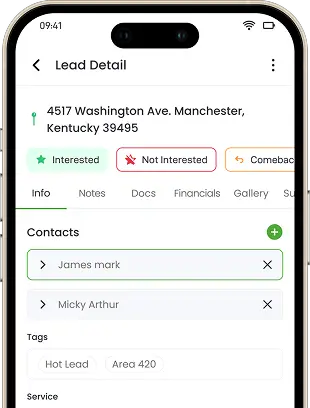
This is exactly where a job record inside Knockio earns its keep. Every property you service, whether it is a driveway or a shopping center lot, can carry its own contact details, contract terms, appointment history, notes from past visits, and files like signed agreements or insurance certificates. Nothing lives in a separate spreadsheet or a filing cabinet. When a commercial client asks for proof of coverage or a copy of last month’s invoice, your team pulls it up in seconds instead of digging through email threads.
Common Pricing Models Used in 2026
How you charge shapes almost everything else in your business. Cash flow. Risk. Even how customers perceive the quality of your work. Think of each pricing model below as one piece of your overall snow removal pricing formula.
Per inch or per depth pricing You charge based on how much snow actually falls. A base rate covers the first few inches, then a fixed amount gets added for every additional inch. This model works well in regions where snowfall totals swing wildly from one storm to the next. Clearing four to six inches typically runs between $60 and $100. Heavier storms add another $3 to $10 per additional inch.
Per visit or per push pricing You charge the same flat rate every time you clear a property, no matter how much snow fell. Simple, predictable, and a good fit for smaller residential jobs. Expect a range of roughly $30 to $70 per visit.
Hourly pricing You get paid for time worked. Straightforward for you, but harder for customers to predict, since nobody knows how long a storm will keep your crew busy. Most hourly shoveling or blowing work runs $25 to $75 an hour.
Seasonal contracts One fixed price covers the entire winter, up to an agreed number of events. Customers like knowing the total cost upfront. You like the predictable income, no matter how mild or brutal the season turns out to be. Seasonal contracts typically range from $200 to $600 per property, though larger properties run much higher.
Hybrid pricing Many companies blend models. A flat per visit rate, plus an added fee if snowfall passes a certain threshold or the crew has to return more than once during a single storm. Heading into 2026, most established snow removal companies lean toward seasonal or hybrid pricing. Both create steadier income, stronger customer relationships, and easier planning for crews and equipment.
Whichever model you choose, every property still needs its own record of what was agreed, what has been billed, and what is owed. In Knockio, each job can carry its pricing model, its contract terms, its visit count, and its payment status in one place, so nobody on your team has to guess which properties are seasonal and which are billed per visit.
The 2026 Cost Factors Behind Every Quote
Before you think about profit, know exactly where your costs come from. Every number in your quote should trace back to something real, not a gut feeling.
Labor Your crew keeps the business moving, literally. Pay needs to cover regular hours, overtime, and the drive time between properties. Good workers are harder to hold onto in cold climates, and wages keep climbing because of it.
Equipment Trucks, plows, blowers, and spreaders all take a beating every winter. Your pricing has to account for maintenance, repairs, and the eventual cost of replacing worn out gear.
Materials Salt, sand, and deicing chemicals fluctuate constantly. Even a ten percent price jump can quietly eat into your margin if your pricing does not adjust with it.
Fuel and transport High fuel prices make every mile between properties more expensive than it used to be.
Insurance Slip and fall claims and property damage are real risks in this line of work, and premiums reflect that. Insurance is a real cost of doing business, not an afterthought.
Administrative and overhead costs Office space, dispatch tools, licensing, accounting, and marketing all add up quietly over a season.
Tracking these costs by hand across dozens of properties gets messy fast. With work orders and job level cost tracking in Knockio, your team can log labor hours, material use, and crew notes against the exact property where the work happened. Over a season, that data tells you which jobs are actually profitable and which ones are quietly losing money.
Step by Step: Calculating Your Snow Removal Price
Once you know your costs, building the price is a straightforward formula.
- Estimate direct labor cost. Crew size times hourly wage times hours on site. Example: Two workers at $30 an hour for 3 hours equals $180 in labor.
- Add material costs. Quantity of salt or deicer times cost per unit. Example: 50 pounds at $0.20 per pound equals $10.
- Calculate overhead. If monthly overhead runs $2,000 against $10,000 in average monthly sales, your overhead rate is 20 percent. Apply that rate to labor plus materials for each job.
- Add your profit margin. Most snow removal companies target 25 to 35 percent. Multiply your total cost base by 1 plus your margin.
- Set your price floor. Never quote below total cost plus your target profit. If the math says $200, that is your floor, not a starting point for negotiation.
This formula keeps your pricing grounded in what the job actually costs, instead of a number pulled from memory or competitor guesswork.
Example Pricing Scenarios
Here is how the formula plays out in real 2026 conditions.
Residential driveway and sidewalk A two car driveway plus a 20 foot sidewalk after a 5 inch snowfall. Two workers spend two hours each at $35 an hour, totaling $140 in labor. Add $15 in salt and 20 percent overhead ($31), and total cost lands at $186. With a 30 percent margin, the final price comes to roughly $242.
Older pricing guides quoted full service jobs as low as $30 to $100 per visit. With fuel, insurance, and labor costs where they sit now, a realistic full service rate is closer to $200 to $250 per visit.
Walkway only service One worker with a snow blower spends about an hour and a half at $35 an hour, or $52.50 in labor. Add $10 in materials and 20 percent overhead ($12.50), bringing base cost to roughly $75. A 25 percent margin puts the final price around $94.
Commercial parking lot A 40,000 square foot lot needs three trucks running three hours each at $40 an hour, or $360 in labor. Add $120 in salt and 25 percent overhead ($120), bringing base cost to about $600. A 30 percent margin puts the final price near $780 per event.
A seasonal contract covering 10 events on that same lot would total roughly $7,800, often with a modest discount built in for long term commitment.
Rising fuel, labor, and insurance costs are the main reason full service pricing sits higher in 2026 than it did just a couple of years back.
Once a job is priced and won, the real work starts. In Knockio, that same property becomes a job record that moves through your pipeline. An accepted estimate can trigger a work order for the crew, which then feeds a scheduled visit, and once the work is done, an invoice goes out tied directly to that same job. Nothing gets re typed between systems, and nothing gets forgotten between the quote and the payment.
When to Adjust Your Rates
Snow removal pricing is not a set it and forget it number. Weather patterns shift. Labor and fuel costs move. Reviewing rates each season protects your margin and keeps the business healthy long term.
Raise your prices when you:
- Have seen costs climb more than 10 percent since last season
- Add faster response guarantees or priority service tiers
- Invest in better equipment or expanded insurance coverage
- Consistently deliver reliable service with more demand than you can currently handle
Hold or lower prices when you are:
- Entering a new market and need to build an initial client base
- Running new routing tools that have measurably cut drive time
- Bundling several small jobs in the same neighborhood to reduce travel
The real skill is balancing customer retention against your own margin. When rates go up, be upfront about why. Most customers respect honesty over a surprise invoice.
Impact of Region, Weather, and Property Type
Location changes everything about your pricing. Heavy snowfall regions like the Midwest or Northeast mean more frequent plowing, more fuel burned, and more wear on equipment. That extra workload is exactly why pricing runs higher in those areas.
In lighter snowfall regions, per visit pricing can run a bit lower, but your base rate still needs to cover fixed costs like insurance and equipment upkeep even during a slow winter. Checking local snowfall history helps you build a seasonal contract that actually reflects typical conditions in your area, not a guess.
Customer type shifts pricing too. Commercial properties usually carry higher rates because of their size, safety liability, and stricter service expectations. A retail plaza often needs faster clearing and multiple passes through the day to stay safe for foot traffic. Homeowners are generally fine with a bit more flexibility on timing as long as the price feels fair.
Surface type and access matter as well. Gravel driveways, narrow lanes, and steep slopes all take longer to clear and put more strain on equipment, so they justify a higher rate. If snow needs to be hauled off site, factor in the drive time and any dumping fees before you send the quote.
Knockio’s map view gives dispatchers a clear picture of which properties sit in which zone, which helps when you are deciding how to price a route with mixed residential and commercial stops, or when you are figuring out which crew is closest to an emergency call during a storm.
The Role of Technology in Pricing Accuracy
Technology has changed how serious snow removal companies price and manage their work in 2026. Cloud based tools now handle estimating and invoicing in a fraction of the time manual methods used to take.
A platform like Knockio’s snow removal software builds digital quotes in minutes, factoring in property size, expected snowfall, and how often a property needs to be cleared. Once the job starts, Knockio helps dispatch crews, tighten routes, and track progress in real time, which means fewer wasted miles, less fuel burned, and more completed jobs per day.
That same data becomes a pricing tool over time. If historical job records show one property consistently takes 35 minutes and another only takes 20, you can adjust rates to reflect actual effort instead of a flat guess applied to every address. Dynamic job statuses in Knockio let you track exactly where each property stands, whether it is scheduled, in progress, completed, or invoiced, so nothing slips through during a busy storm week.
Once pricing is backed by real data, automation takes over the repetitive parts. Knockio’s automation flow builder can send payment reminders, trigger follow up messages, and update job statuses automatically, freeing your office staff to focus on the properties that actually need a phone call.
Communicating Value and Winning Jobs
Charging more than a competitor is not a problem if customers understand exactly what they are paying for. Transparency builds trust, and trust is what actually wins the job.
Break your quote into its parts. Plowing, walkway shoveling, salting, follow up checks, and insurance coverage. When customers see the breakdown, they question the total far less often.
Define your response time clearly. Something like “we respond within two hours once accumulation passes two inches” removes ambiguity before it becomes a complaint.
Sending a clean, professional quote through a system like Knockio signals that your business runs on real process, not guesswork. Customers can review and approve estimates online, complete with digital signatures, and get instant confirmation the moment they accept. If a customer pushes back on price, steer the conversation toward value. Mention your insurance, your reliable equipment, and your ability to track every visit digitally. Cheaper competitors often skip insurance or miss response windows, and for a commercial client, a missed deadline can turn into an accident or a lawsuit that costs far more than a slightly higher invoice.
Seasonal contracts deserve their own conversation. A fixed rate covers the whole season up to an agreed number of events, which gives the customer predictable costs and gives you steady income. Since that income is locked in, per event pricing usually runs a bit lower than one off jobs would command.
Managing seasonal contracts by hand invites billing mistakes. Knockio automatically tracks visit counts against the contract limit and flags the office once a property approaches its cap, which makes it far harder to accidentally underbill a client or lose track of how many events have already been used.
For payment collection itself, Knockio supports text to pay, tap to pay, credit card, and ACH options, along with manual entry for accounting purposes. Whichever method a customer prefers, the payment updates the job record automatically through invoicing and payments that stay in sync, so your books and your job history always match.
Regional Market Insights for 2026
Pricing still varies a lot depending on where you operate. Here is a general sense of where things sit heading into this winter.
Northeast US and Canada: Heavy snow, expensive labor, and high insurance costs push residential driveway pricing to roughly $200 to $350 per visit, with commercial lots climbing well past $1,000.
Midwest: Similar conditions to the Northeast with slightly lower fuel costs. Expect $150 to $300 for driveways and $700 to $1,200 for larger commercial lots.
Pacific Northwest: Less frequent snowfall means higher per visit rates to cover fixed costs, typically around $250 for residential work and $800 or more for commercial properties.
Mountain regions: Steep terrain and added risk push rates to $300 to $500 per visit.
Treat these figures as a starting reference, not a rulebook. Your real number always needs to cover your actual crew wages, equipment costs, and overhead.
Advanced Pricing Strategies
Once the basics are dialed in, a few advanced moves sharpen your snow removal pricing formula further.
Track cost per event. Log time, materials, and travel for every job. At season’s end, compare real cost per event against what you charged, then adjust for next year.
Use tiered pricing. Offer a Standard tier covering plowing and basic salting, a Premium tier adding walkways and faster response, and an Ultimate tier that includes roof removal, hauling, and priority scheduling around the clock. Tiers let you serve both price sensitive customers and higher expectation clients from one service menu.
Add storm severity surcharges. Spell out in your contract what counts as a normal storm versus an extreme one. A common approach adds a 30 percent surcharge once snowfall passes 8 inches, protecting your margin during unusually heavy weather.
Bundle services. Pairing snow removal with fall cleanup or spring landscaping contracts smooths out your cash flow across the full year and keeps customers loyal longer.
Review pricing every year. Each August or September, look back at the previous winter’s numbers. Adjust for inflation, fuel changes, and any new service tiers before marketing to clients again.
Knockio’s boards and job views make this kind of review far easier, since a full season of job history, notes, and invoices already sits in one place instead of scattered across paper tickets and old spreadsheets.
Sample 2026 Pricing Ranges
| Service Type | Typical 2026 Range |
|---|---|
| Single car driveway | $180 to $250 per event |
| Two car driveway plus sidewalk | $225 to $350 per event |
| Sidewalk or walkway only | $80 to $130 per visit |
| Roof snow removal | $300 to $1,500 depending on size |
| Commercial lot | $600 to $1,500 plus per event |
Use these numbers as a reference point. Weather, fuel costs, and your own operating model will shift the final figure up or down.
Pre Quote Site Visit Checklist
Assess every property carefully before sending a quote. Ask:
- What is the total area and surface type?
- Are there obstacles like curbs, fences, or parked vehicles?
- Is there room to pile snow, or does it need to be hauled off site?
- How steep is the driveway or lot?
- What response time does the customer expect?
- Do they require salt or deicing chemicals?
- Are there accessibility concerns for pedestrians?
- How many visits per event should be expected?
Answering these questions before quoting keeps your price tied to the actual workload rather than an assumption. Notes, photos, and custom fields on the job record in Knockio let your team capture these details once, during the site visit, so nobody has to rely on memory when it is time to build the estimate.
Building Long Term Profitability
Pricing is only one piece of a profitable snow removal business. Real strength comes from running efficiently, keeping loyal clients, and paying attention to your own data.
A connected system like Knockio supports all three. Routing, job assignments, time tracking, photo documentation, and billing all live under one roof instead of across five or six disconnected tools. Over a full season, that data shows exactly where your profit is actually coming from, so you can decide which types of jobs to chase harder and which ones to walk away from.
Fast, professional service builds trust. Customers who see quick quoting and accurate billing tend to push back less on price, because the process itself signals that your business is organized and reliable.
Pair that operational discipline with consistent marketing. Keep your Google Business Profile updated, make sure your site targets searches like “snow removal near me,” and stay visible on social media through the winter months, not just at the start of the season.
Conclusion: Pricing Smart in 2026
Snow removal pricing in 2026 comes down to three things. Transparency, real data, and operational efficiency. Balance accurate cost figures with clear communication and the right technology, and the business side of winter gets a lot less stressful.
Before you settle on a final number, make sure labor, overhead, materials, and a healthy profit margin are all baked in. Adjust for weather and job complexity, but never undercut your own value just to win a job. A cheap win rarely pays off once the real costs show up.
Running your snow removal business on one connected workflow platform instead of five or ten separate tools frees up the time and money you need to stay competitive as costs keep climbing. When a client asks why they should choose you, the answer becomes simple. Accurate pricing, reliable service, modern communication, and proven efficiency, backed by a system that keeps every job, invoice, and payment organized in one place.
Stick to a real formula this season, and your winter will not just be busy. It will be profitable and predictable, built on solid numbers instead of guesses.
1. What is a snow removal pricing model?
It is just the formula that your business uses to set the price for snow-removal jobs. It includes everything from your crew’s time to the size of the property, equipment, and salt. Generally, businesses charge per visit, per inch, hourly, or with a flat-rate seasonal contract.
2. How does per-visit snow removal pricing work?
With Per-visit pricing, you agree to charge one flat rate each time you clear the snow, no matter how deep it is. Homeowners love it because it is simple and predictable, and you get a steady income every time your plow hits the ground!
3. What is per-inch snow removal pricing?
In per-inch pricing, your price changes with the amount of snowfall. You charge a flat fee for the first few inches, and then add a fixed rate for every inch that falls after that. This pricing model is ideal for places where you don’t know if you will be getting a blizzard or some dusting.
4. How do hourly snow removal rates work?
With hourly rates, you get paid for the time you have put in to get the work done. It includes labor and equipment costs. The only downside of this is that it’s hard for the customers to calculate what the final cost would be.
5. What is a seasonal snow removal contract?
In a seasonal contract, you set one fixed price for the whole winter season, usually up to a set number of snow events. This is great because you get a steady income and your client doesn’t have to worry about a surprise bill.
6. How do commercial and residential snow removal prices differ?
Commercial jobs come with a bigger price tag. These jobs consume heavy machinery, bigger teams, huge insurance policies, and the need to clear the lot instantly. Residential jobs are smaller and easier, but you’ll usually find the price per square foot is actually higher for that neighborhood driveway!
7. What factors affect snow removal pricing in 2026?
To calculate your price means checking every expense. That means including what you pay your crew, equipment maintenance, the cost of fuel and salt, and insurance. Inflation and labor shortages in 2026 are pushing up costs in North America, so this will reflect in snow removal rates across North America.
8. What is the essential snow removal pricing formula to calculate a fair price?
To set a perfect price, you need to cover your expenses like labor, materials, fuel, and overhead costs. Then, add a healthy 25% to 35% profit margin. When you keep track of all your costs per job, you will get better at setting the perfect price every time.
9. Why do some contractors offer hybrid pricing models?
Hybrid pricing models give you the best of both worlds. It lets you combine different pricing types, like you might offer a flat seasonal fee, but add a specific charge if there is a huge, unexpected storm. This way, you get a predictable income and are also covered if the weather gets extreme.
10. How can software improve snow removal pricing accuracy?
With software like Knockio Snow Removal Software, you can ditch the paperwork and run your business on data. It automates quoting and tracks everything happening on the job in real-time. This way, you can easily calculate accurate costs, optimize your routes for speed, and update your prices faster using real data, instead of guesswork.

Waqar Hussain leads SEO and digital media at Knockio, a field sales and field service management (FSM) platform for businesses managing sales reps, field teams, jobs, and customer appointments. He focuses on content strategy, search growth, and digital media to help more teams discover better ways to manage leads, jobs, and field operations.