Summarize with:
Summary:
Field sales teams lose time, burn gas, and frustrate homeowners when canvassing territories rely on guesswork instead of data. This guide breaks down the four rules of smart territory management: targeting by home service signals, mapping natural boundaries, timing knocks with the 3-Pass Method, and eliminating windshield time. It also shows how live mapping tools like Knockio prevent double-knocking and give managers the real-time GPS visibility needed to maximize lead density.
This is the masterclass on building a real field sales territory strategy—the kind that turns door-to-door canvassing from a numbers game into a science. Grab your coffee. Let’s map this out.
The 4 Golden Rules of Territory Density
Territory density isn’t about drawing bigger circles on a map. It’s about making sure every square foot your reps walk has a real reason to be walked. Here are the four rules that separate high-density canvassing operations from the teams still winging it.
Rule 1: Target Neighborhoods Based on Real Service Signals, Not Gut Feel
The best territories aren’t chosen because “that neighborhood looks nice” or “we’ve always worked that side of town.” They’re chosen because the data says the homes there actually need what you sell.
For solar, that means looking at:
- Home age and roof condition – older roofs often need replacement before or alongside a solar install, which changes your pitch entirely.
- Utility rates and sun exposure in that specific zip code.
- Roof orientation and pitch, which you can often eyeball from satellite view before a single knock happens.
For roofing, the signal is almost always housing age. Neighborhoods built in the same construction wave tend to need roof replacement in the same wave, too—asphalt shingles typically last 20-25 years, so a subdivision built in the early 2000s is prime territory today. The U.S. Census Bureau’s American Community Survey publishes median year structure built data broken down by neighborhood and census tract, and it’s one of the most underused free tools in the industry. Cross-reference that with recent hailstorm or wind-damage maps and you’ve got a shortlist of neighborhoods worth prioritizing before you print a single door hanger.
For HVAC, home age matters too, but so does system age—which you often can’t know until you’re standing at the door. That’s why HVAC teams tend to combine home-age targeting with service history data (past customers, past leads, warranty expirations) to build their priority list.
The bottom line: Don’t send reps into a neighborhood because it’s close to the office. Send them because the houses there are statistically more likely to say yes.
Rule 2: Use Natural Boundaries, Not Random Boxes
This is the rule most managers get wrong, and it’s an easy fix. Nothing hurts rep morale faster than realizing three team members knocked on the exact same street in the same week.
You’ve seen it happen. Rep A worked Maple Street on Monday. Rep B, not knowing any better, worked it again on Wednesday. By the time Rep C rolls through on Friday, the homeowner at 214 Maple has answered the door three times for three different reps pitching three slightly different versions of the exact same solar offer. She’s annoyed. Your reps are burned out from knocking on dead doors. And somewhere across town, a genuinely hot neighborhood, new roofs going up, AC units wheezing through their fifteenth summer, sits completely untouched because nobody was assigned to go there.
That’s guesswork canvassing. It feels like an activity. It looks like a full calendar. But it’s actually chaos wearing a clipboard.
Now picture the other version. Every rep opens their app in the morning and sees a color-coded map. Green pins are fresh territory, ready to knock. Yellow pins are follow-ups from last week. Red pins are “do not knock” – already covered, already closed, or already said no twice. Nobody’s stepping on anybody’s toes. Nobody’s burning gas driving across town to knock three houses. Every door gets hit at the right time, by the right rep, with the right pitch. That’s smart canvassing territory management—and it’s the single biggest lever most home service companies aren’t pulling hard enough.
When you draw territories as neat rectangles on a grid, you’re ignoring how neighborhoods actually work. Real neighborhoods are shaped by:
- Main roads that people don’t casually cross on foot
- Rivers, creeks, and greenbelts that break up walkability
- Cul-de-sacs and gated entrances that naturally cluster homes together
- HOA boundaries, which often correlate with build year and home style
When your territory lines follow these natural edges instead of arbitrary grid boxes, two things happen. First, reps stop wasting time walking to the “technical” edge of their zone just because a line on a map says so, when a four-lane road or a creek makes that edge meaningless in real life. Second, you avoid the classic overlap problem—two reps assigned to boxes that both happen to include the same cul-de-sac (dead end) because the box lines split it awkwardly.
Quick test: If you had to explain your territory boundary to a brand-new rep in one sentence—”you’ve got everything between Oak and the river”—it’s a good boundary. If it takes a paragraph, redraw it.
Rule 3: The 3-Pass Method – Why Timing Doubles Your Contact Rate
Here’s a number that should change how you schedule shifts: industry benchmarks on door-to-door contact rates put a realistic contact rate in suburban residential territory at 30% to 50% of doors knocked. Evening hours between 5 pm and 8 pm on weekdays push that number toward the top of the range, while midday knocking frequently drops it below 20%.
That’s not the only timing lever, either. Field canvassing research on second-knock timing has found that a second knock scheduled at a different time—evenings and weekends—typically yields higher contact rates than a single midday pass ever will.
That’s the entire logic behind the 3-Pass Method:
- Pass 1 (Weekday afternoon): A light first sweep. You’ll catch retirees, remote workers, and stay-at-home parents. Log everyone who’s not home—don’t waste time here.
- Pass 2 (Weekday evening, 5-8pm): This is your money window. Working homeowners are back, dinner’s not quite on the table yet, and people are more receptive to a five-minute conversation on the porch.
- Pass 3 (Weekend morning or early afternoon): Mop up whoever you missed on the first two passes, and re-engage anyone who said: “come back later.”
Most teams only do Pass 1. They knock once, mark the house as “not interested” or “not home,” and move on forever. That’s leaving half your neighborhood’s potential on the table. The 3-Pass Method isn’t about knocking harder—it’s about knocking smarter, at the times people are actually answering the door.
Rule 4: Cut Out the Windshield Time
“Windshield time” is the industry term for every minute your rep spends driving instead of knocking, and it is quietly the most expensive line item most canvassing managers never track. Route optimization data from field service platforms shows that tools which intelligently sequence stops can reduce windshield time by as much as 30%, and broader research on field team productivity shows automated routing can lower fuel costs by up to 20% and reduce travel time by up to 28%.
Think about what that actually means in hours. Field studies estimate a realistic knock rate of 15-20 doors per hour in a standard suburban neighborhood when reps aren’t wasting time driving between disconnected blocks. Every extra ten minutes spent backtracking across town because your territories are scattered instead of contiguous is ten minutes that could’ve been three more doors knocked. Multiply that across a ten-rep team, five days a week, and windshield time isn’t a minor inefficiency—it’s a full extra rep’s worth of production you’re throwing away every month.
The fix is almost always the same: assign contiguous, walkable territories (see Rule 2), and use a canvassing route planner to sequence each rep’s daily path into a logical loop instead of a zigzag back and forth across a neighborhood they already half-covered.
Easy Comparison: Guesswork vs. Smart Canvassing Territory Management
Sometimes the clearest way to see the gap is side by side.
| Workflow Stage | Guesswork Canvassing | Smart Territory Management |
|---|---|---|
| Neighborhood selection | That side of town looks promising | Home-age, roof-age, and utility data drive the shortlist |
| Territory boundaries | Arbitrary boxes on a paper map or spreadsheet | Natural boundaries (roads, rivers, HOA lines) |
| Overlap risk | High – multiple reps hit the same street unknowingly | Near-zero – live pins show exactly what’s covered |
| Timing strategy | One pass, whenever a rep happens to be free | 3-Pass Method targeting peak contact windows |
| Driving pattern | Scattered, reactive, lots of backtracking | Sequenced, contiguous routes that minimize windshield time |
| Data capture | Paper notes or nothing at all | Every knock logged, tagged, and mapped in real time |
| Rep morale | Frustrated by dead doors and wasted gas | Confident – always knows where to go next |
| Manager visibility | Finds out about overlaps after a homeowner complains | Sees the whole team’s coverage live, from the office |
The Role of Live GPS and Mobile Mapping
Here’s the honest truth: you can know all four Golden Rules by heart and still fail if your reps are working off a paper map or a mental note of “I think Dave covered that block already.” Territory strategy only works if it’s visible and live—which is exactly what modern D2D canvassing software and door-to-door sales mapping tools were built to solve.
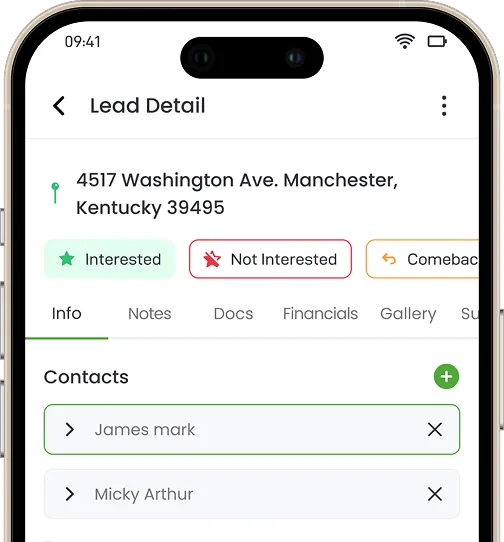
That’s exactly the gap a tool like Knockio’s live territory mapping feature is built to close. Instead of a static spreadsheet or a whiteboard back at the office, every rep’s phone shows a live, color-coded map of the neighborhood:
- Green for untouched, ready-to-knock addresses
- Yellow for callbacks, appointments, or “come back later” flags
- Red for already-knocked, already-closed, or do-not-disturb addresses
When a rep marks a door, that pin updates instantly for the whole team—not at the end of the day, not after a manual data upload, but in real time. So if Rep A knocks 214 Maple at 10 am, Rep B’s map already shows it red by 10:01. No more accidental overlap. No more awkward moments of two reps meeting each other mid-block.
This is also where Knockio’s live GPS rep-tracking dashboard pays off for managers. From the office, you can see exactly where every rep is right now, which streets are covered, and which green zones are sitting untouched at 4:45 pm—the exact window you now know is about to become prime knocking time thanks to Rule 3. You can redirect a rep who’s ahead of schedule into an unfinished zone before the evening window closes, instead of finding out three days later that a whole street never got its second pass.
Put simply: the Golden Rules tell you how to divide the map. Live mapping tools are what actually makes the division hold once ten reps are out in the field at the same time.
Your Territory Launch Checklist
Ready to actually redraw your map instead of just nodding along? Here’s the short version to run through before your next canvassing cycle:
- Pull the data first. Before you assign a single street, check median home age for the neighborhood (ACS data is free), recent storm damage reports if you’re in roofing, and utility rates if you’re in solar.
- Trace boundaries by hand on a real map, not a spreadsheet grid. Walk the natural lines—main roads, waterways, HOA gates—and let those define the zone.
- Build in three touch windows per territory before you write it off. One afternoon pass, one evening pass, one weekend pass. Don’t let a rep mark a house “dead” after a single missed knock.
- Assign contiguous zones, not scattered addresses. A rep should be able to walk their entire territory in a loop without backtracking.
- Put it on a live map, not a printed sheet. If the second two reps can’t see each other’s coverage in real time, the whole system breaks down.
- Review coverage weekly. Look for green zones (untouched) that are sitting stale past their prime knocking window, and red zones where a second or third pass never actually happened.
None of this requires a data science degree or expensive software rollout; it requires discipline, the right boundaries, and a map everyone on the team can see at the same time.
Bringing It All Together
Territory management isn’t glamorous. Nobody puts “I drew really good boundary lines” on their sales awards. But it is, quietly, the highest-leverage decision a canvassing manager makes before a single door ever gets knocked.
Get the four rules right—target by real service signals, draw boundaries that match how neighborhoods actually work, knock in three smart passes instead of one lazy one, and kill windshield time—and you’ll see it show up everywhere that matters: more doors knocked per rep per hour, fewer duplicate knocks, higher contact rates, and reps who go home energized instead of exhausted from driving in circles.
The neighborhoods aren’t going anywhere. The homes with 20-year-old roofs and straining AC units are already out there, waiting for someone to knock at the right time. The only question is whether your team finds them with a strategy—or stumbles onto them by accident, three reps at a time.
Sources
- U.S. Census Bureau — American Community Survey housing stock age data by neighborhood
- Rework: Door-to-Door Sales Funnel — contact rate and address penetration benchmarks
- Qomon: What Is Door-to-Door Canvassing — effective field action timing data
- MSDynamicsWorld: How route optimization reduces windshield time
- Maptive: How route optimization reduces travel time and boosts productivity
- SparkMap: Housing Stock Age data methodology

Syed Junaid is the Marketing Lead & Content Strategist at Knockio, where he helps field sales and service businesses eliminate software bloat and scale their operations. He writes about B2B SaaS growth, field sales strategies, and how contractors can eliminate the “Duct-Tape Tax” to run more profitable businesses.